

Schema markup has changed from an optional SEO enhancement into a fundamental driver of search visibility. Structured data acts as a direct communication channel between your content and search engines. It provides the context that search engines like Google need to understand and display your information.
Websites that implement structured data appear a lot more often in AI-generated responses and rich results compared to those without it. Moreover, AI Overviews continue expanding their presence in Google searches of all types. This makes schema markup strategies critical to maintain competitive visibility.
We cover implementation techniques and validation approaches along with performance optimization.
Advanced Schema Markup Overview
- Schema markup has shifted from an optional SEO tactic to a core visibility driver, with AI Overviews and generative search now actively pulling from structured data to surface and cite content.
- JSON-LD is the recommended implementation format — it keeps structured data separate from HTML, making it easier to maintain and update without risking layout disruption.
- Prioritising the right schema types matters more than implementing everything: Organization, Article, Product, FAQPage, and AggregateRating deliver the clearest visibility and click-through gains.
- Validation and ongoing monitoring are essential — schema breaks silently when content, plugins, or themes update, so regular checks via Google Search Console and the Rich Results Test are non-negotiable.
- Structured data also feeds Knowledge Graph integration, reducing AI hallucinations and increasing the likelihood that your content gets cited accurately in AI-generated responses.
Understanding Schema Markup for Modern Search Visibility
Search engines excel at indexing content, but understanding the true meaning behind that content remains a challenge. Structured data markup bridges this gap. It provides explicit context that machines can interpret without guesswork. Algorithms no longer need to guess whether a string of text represents a product price, review rating, or publication date. Schema markup delivers precise definitions that eliminate ambiguity.
Schema.org vocabulary is the foundation of this standardized communication. Google, Microsoft, Yahoo, and Yandex developed this shared framework together. It ensures consistent interpretation across major search platforms. The vocabulary defines entities, relationships, and properties in a format that artificial intelligence systems can process.
To put simple, you’re creating a semantic data layer that sits next to your visible content once you implement schema markup. This layer explains what each element means and how different pieces of information connect. JSON-LD has emerged as the preferred format. This JavaScript notation embeds structured information within script tags and keeps it separate from your page’s visible content.
What are Rich Results in Schema Markup?
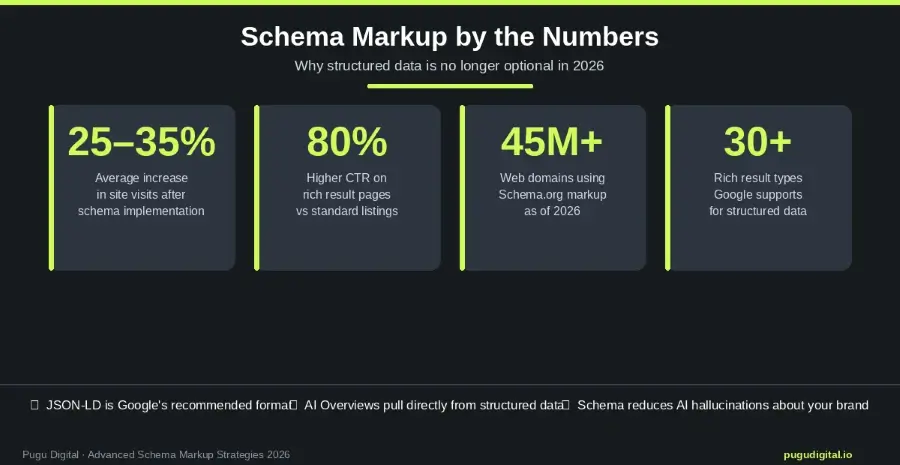
Rich results represent the most visible benefit of structured data implementation. Google supports more than thirty different result types. Each is designed to display specific information in search listings. Recipe pages can showcase cooking times and ingredient lists directly in search results. Product listings display pricing, availability, and review ratings before users click through. Event markup enables calendar integration and location details to appear right away.
The measurable impact extends beyond visual improvements. Websites that implement Schema markup see an average of between 25% to 35% increase in visits after implementing advanced schema. They also see an increase up to 80% in higher click-through rate for rich result pages versus standard listings. Visitors also spend longer time on structured data pages.
Schema markup additionally prepares your content for AI-driven search experiences. Voice assistants and generative search tools rely on structured data to extract and present information. Over 45 million web domains have adopted Schema.org markup as of 2026. This reflects widespread recognition of structured data’s role in modern search visibility.
Essential Schema Types That Drive Search Visibility
Selecting the right schema types used to be quite a complicated process with older formats like Microdata and RDFa, requiring inline markup that intertwined with HTML elements. Today, JSON-LD’s clean separation allows technical teams to update structured data without risking disruption to page layouts or user-facing content.
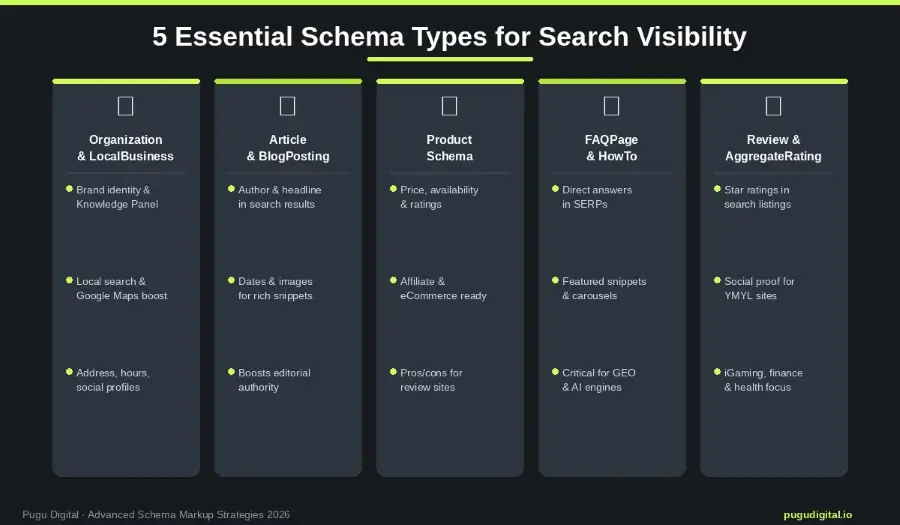
Focus on strategic schema types aligned with your content goals rather than implementing every available markup option. This produces measurable visibility gains. Let’s check some of the most common types of Schema we here at Pugu Digital add to websites to improve rich snippets and structured data.
Organization and LocalBusiness Schema for Brand Recognition
Organization schema provides search engines with basic business information, including official name, logo URL, website address, and social media profiles. This markup influences Knowledge Panel displays and establishes your brand identity across search properties. LocalBusiness schema extends these features for physical locations.
It specifies address details, geographic coordinates, operating hours and service categories. The markup boosts local search positioning and Google Maps visibility. Customers can access contact information and business details without visiting your website.
Article and BlogPosting Schema for Content Authority
Article markup helps search engines understand news stories, blog posts, and editorial content. It defines headlines, author information, publication dates, and representative images. The structured data makes pages eligible for rich snippets.
Author names and publication timestamps display in search results. Required properties include author name, headline image and publisher details with publisher logo. Recommended additions cover author URL and date modified fields.
Product Schema Markup with Rich Results Integration
Product schema separates into two distinct applications. Product snippet markup applies to pages where users cannot complete purchases, such as review sites and affiliate content. This type displays ratings, pros and cons, and pricing information without direct transaction features.
Standard Product schema serves ecommerce platforms. It provides complete details, including name, description, price, availability, and customer reviews.
FAQPage and HowTo Schema for Featured Snippets
Probably one of the most important schemas if you want to be shown in GEO engines and search results. FAQPage schema structures question-and-answer content for direct display in search results. It may reduce bounce rates by answering queries on the spot.
HowTo markup outlines step-by-step instructions with required tools, materials, and completion time. Both types qualify for better search appearances, including carousels and expandable result boxes.
Review and AggregateRating Schema for Trust Signals
Review schema displays star ratings and review excerpts in search listings. This proves extra important for YMYL (Your Money or Your Life) websites that cover industries like iGaming, finance, health and medical, as well as shopping and e-commerce.
Single ratings show individual reviewer scores. Aggregate ratings present average scores across multiple reviews. This markup applies to products, online gambling, local businesses, movies, books, and software applications. It provides social proof that influences click decisions.
Advanced Implementation Strategies Using JSON-LD
JSON-LD has become the standard for implementing structured data markup because it solves problems that plague older formats. Google recommends JSON-LD for structured data, and their parsing tools are optimized for this format.

Why JSON-LD Schema Markup Outperforms Microdata
JSON-LD beats Microdata and RDFa for several reasons. Separation of concerns means your structured data lives in script tags rather than tangled into HTML attributes. You can modify markup without touching page layout.
The graph model supports @id references that connect entities into coherent knowledge graphs and mirrors how search engines organize information. Microdata requires attributes on HTML tags, which makes it fragile when developers change page structure.
Nested Schema Markup for Complex Content Structures
Nesting embeds one schema type within another to show relationships. Embedding the review inside the product tells search engines which review belongs to which item instead of using separate Product and Review blocks.
The @graph property allows declaring multiple entities in a single JSON-LD block and creates cleaner code than multiple script tags.
Dynamic Schema Implementation for Single-Page Applications
JSON-LD works naturally with single-page applications where content loads on the fly. Populate your markup using server-side variables to verify structured data always matches user-facing content.
Static JSON-LD creates trust issues when your HTML displays different pricing than hard-coded schema.
Schema Validation Tools and Error Prevention
The Rich Results Test checks whether your markup qualifies for improved search appearances. Schema.org’s validator provides general syntax checking.
Common errors include missing commas, invalid properties that don’t belong to the schema type, and absent required fields.
Maintaining Schema Accuracy with Content Updates
Search Console’s Enhancements section shows which rich result types Google detected, how many pages have valid markup, and which contain errors.
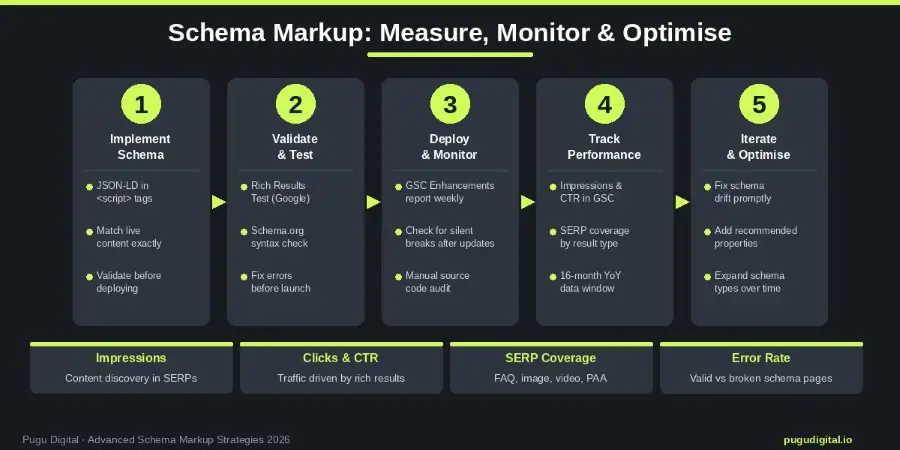
Check weekly because schema breaks silently when content updates, plugins upgrade, or themes modify. Manual source code verification catches duplication issues that automated tools miss.
Measuring Schema Impact and Optimizing Performance
Structured data performance tracking needs systematic measurement approaches that connect schema implementation to search visibility gains. Google Search Console provides the main analytics infrastructure to monitor how your markup influences search appearance and user engagement.
Google Search Console Rich Results Test Analysis
The Rich Results Test confirms structured data markup and previews how Google might display your content in search results. Run this test during development to catch formatting errors before deployment.
After deployment, Enhancement reports track validity throughout your site and show which pages qualify for rich results and which contain errors. Google Search Console maintains a 16-month data window. This creates a three-month overlap with the previous year and makes year-over-year comparisons possible.
Tracking Rich Snippets Performance in SERPs
Performance measurement focuses on specific KPIs that reveal schema effects. Impressions show how often your content appears in search results, with structured data increasing the discovery of high-value content.
Clicks measure actual traffic driven to your site, while click-through rate divides clicks by impressions. SERP coverage tracks which universal search result types display your content, including images, FAQs, videos, and People Also Ask boxes.
Schema Markup Errors and Their SEO Effect
Errors show missing required properties that disqualify pages from rich results eligibility. Warnings show absent recommended properties, but pages remain eligible and lack full feature sets.
Schema drifts occur when vocabulary changes at schema.org, Google updates rich result guidelines, or website content modifications break existing markup.
Knowledge Graph Integration Through Structured Data
Structured data enables Knowledge Graph connections by defining entities and relationships in a format AI systems can interpret with confidence. Schema markup for organisations, people, products, or events, maps your content against established knowledge bases, driving rich results and authoritative presence.
Keeping schema accurate as pages update ensures consistency between structured data and live content, a key trust signal for AI visibility.
Advanced Schema Markup Strategies Conclusion
Schema markup has moved well beyond a technical nicety. It is now a core component of any serious SEO strategy. From Organisation and Product schema to FAQPage and AggregateRating markup. Each implementation layer adds context that search engines and AI systems rely on to surface, cite, and trust your content.
Pugu Digital’s SEO specialists provide in-depth schema audits, implementation strategy, and ongoing performance monitoring to ensure your structured data is always accurate, validated, and working in your favour. Whether you’re starting from scratch or optimising an existing setup, we make sure your schema keeps pace with search engine updates and delivers measurable results.
Get in touch with Pugu Digital today, and let’s make your structured data a competitive advantage.
Schema Markup FAQs
What makes advanced schema markup different from basic implementation?
Advanced schema markup provides more detailed and comprehensive information to search engines beyond basic elements. While standard schema might only include fundamental details like article titles, authors, and publication dates, advanced strategies involve nested structures, dynamic implementation for complex content, and strategic combinations of multiple schema types to create richer semantic connections that enhance search visibility.
Is schema markup still important for SEO in 2026?
Yes, schema markup remains essential for modern SEO strategies. As search engines become increasingly sophisticated at interpreting content and user intent, structured data continues to serve as a cornerstone for making your content visible and easily understood. With AI-powered search systems reshaping content discovery, websites with proper schema implementation appear significantly more often in AI-generated responses and rich results compared to those without it.
How can I optimize my content for AI-driven search results?
To optimize for AI-driven search, focus on creating AI-ready content with proper structured data implementation, which serves as a trust signal for search engines. Leverage schema markup to provide explicit context that AI systems can reliably interpret, reducing the likelihood of misrepresentations. Additionally, align your content strategy to match generative search engine expectations and treat AI search as part of your brand reputation infrastructure.
What are the most effective on-page SEO techniques for 2026?
The most effective on-page SEO techniques include semantic topic mapping, structured data implementation, conversational intent optimization, and AI-ready content formatting. These approaches focus on creating content that matches the expectations of both traditional and generative search engines, with emphasis on providing clear context through schema markup and organizing information in ways that AI systems can easily process and cite.
How do I measure the impact of schema markup on my website’s performance?
Measure schema impact through Google Search Console by tracking key performance indicators including impressions, clicks, and click-through rates for pages with structured data. Use the Rich Results Test to validate markup and monitor Enhancement reports to identify which pages qualify for rich results. Track SERP coverage across different result types and compare performance metrics over time, utilizing Search Console’s 16-month data window for year-over-year analysis.