

GEO for local and International markets requires systematic implementation of structured content, consistent monitoring, and adaptation to how AI systems discover and cite authoritative sources across geographic markets.
There is still time to be part of this evolution as traditional search is still important. But the window for establishing AI visibility is closing faster than many of us professionals expected.
AI-powered search tools and voice assistants are rapidly surging in popularity. This changes how we need to approach digital visibility.
Businesses that target multiple regions need GEO for local and International markets to ensure they appear in AI-generated responses in every geographic market they serve. In this guide, we’ll walk you through a step-by-step process to implement geographical Generative Engine Optimization strategies.
Key Takeaways Implementing GEO for Local and International Markets
- Audit your current GEO for local and International markets visibility across platforms like ChatGPT, Perplexity, and Google AI Overviews to establish baseline performance.
- Create location-specific content clusters with structured data and schema markup to help AI systems understand and cite your content.
- Build multi-platform presence focusing on user-generated content, as platforms like Reddit and YouTube show high AI citation rates.
- Implement clear content structure with quick answers, comparison tables, and numbered processes to improve generative AI extractability by 30-40%.
- Track citation rates and brand mentions across AI platforms, as only 16% of brands currently monitor generative search performance.
- Focus on third-party content strategy since 65% of AI responses in many industries come from publishers and user-generated sources.
Understanding GEO for Geographic Markets
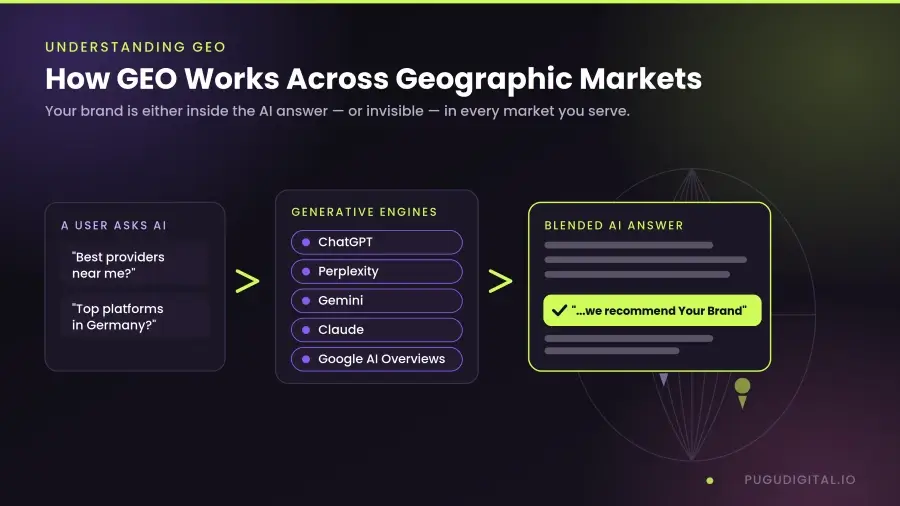
Generative Engine Optimization represents the practice of earning visibility and citations within AI-generated search responses from platforms like Google AI Overviews, ChatGPT, Perplexity, Gemini, and Claude. The term was formalized in November 2023, marking a distinct move in how businesses approach digital visibility across different geographic regions.
Traditional SEO focuses on ranking position in search engine results pages. GEO, as opposed to this approach, wants to position your content as a source that AI engines cite when answering user queries. The difference matters because AI platforms blend information from multiple sources into single, direct answers rather than displaying ranked lists of regional businesses.
At the time someone asks an AI tool about services in their city or products available internationally, the response has specific brand mentions and recommendations. Your business either appears in that answer or remains invisible. Hence, only implementing GEO is normally not enough. Just like in SEO, it needs to be geographically targeted.
Mechanisms Behind GEO Optimization
The mechanisms behind Generative Engine Optimization differ from traditional optimization in fundamental ways. AI systems prioritize brand authority, content structure, entity recognition, and clear writing that can be extracted and attributed with accuracy. These platforms study multiple authoritative sources and blend knowledge into natural responses. They predict what information comes next based on patterns from trusted content.
The move in search behavior carries measurable consequences. Gartner predicts that traditional search engine volume will decrease by 25% by 2026. Research shows that 80% of search users now rely on AI-generated summaries for at least 40% of their searches, contributing to a 15% to 25% drop in traditional website traffic.
Maybe most important, roughly 60% of search queries now end without the user clicking through to any website. Brands in the bottom half of web mentions receive zero to three AI citations, while top performers average 169 mentions. Ninety percent of B2B buyers use generative AI at some point in their buying experience.
Geographic Targeting
Google continues expanding where AI Overviews appear. Some navigational queries that surfaced Google Maps and review listings before now trigger AI Overviews instead. Businesses with the strongest reviews or local presence have no guarantee they will be mentioned first in AI-generated responses.
Companies without a GEO for local and International markets strategy are experiencing double-digit declines in search traffic as users get answers from AI tools rather than traditional search engines. Appearing in AI answers represents valuable exposure and brand recognition that doesn’t require paid advertising for geographic expansion into local and international markets.
Preparing Your Business for GEO Implementation
You need baseline data and clear direction before you implement any GEO strategy in geographic markets. You can even contact us directly for a free consultation. Most marketing teams operate without understanding their current AI visibility. This makes it impossible to measure improvement or identify gaps that prevent citations in local and international markets.
Audit Your Current Digital Presence
Establish what you don’t know first. Query major AI platforms with searches relevant to your business in the regions you target. ChatGPT and Google AI Overviews average three to four brand citations per response. Perplexity provides wider coverage with 13 average citations. Bing Chat and Copilot often surface different sources than Google and reveal alternate visibility opportunities.
Four Questions Guide Your Audit
- Does your brand get mentioned when users ask about your category in specific markets?
- Which competitors appear in AI responses where you’re absent?
- What sources do AI systems cite for topics you should own?
- How does your visibility differ in platforms and geographic queries?
The visibility distribution reality reveals stark divides. Roughly 26% of brands have zero mentions in AI Overviews. The distribution concentrates on the following:
- Brands in the top quartile by web mentions average 169 mentions in AI responses.
- Those in the 50-75% range average 14 mentions.
- The bottom half receives zero to three mentions.
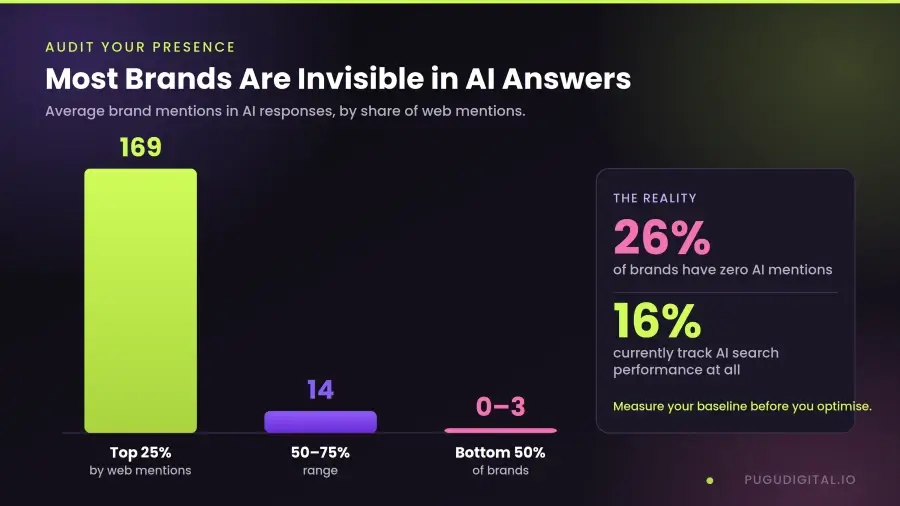
You’re invisible to AI systems serving answers to potential customers if you’re in the bottom half.
Check your Google My Business listing, website NAP information, and data accuracy on local directories for geographic targeting. Review consistency in all platforms where your business appears regionally.
Identify Your GEO Target Markets and Audiences
Map your content to customer journey stages. AI citation behavior is very different in awareness, consideration, and decision phases. The below table vizualize this in a clear explanatory way:
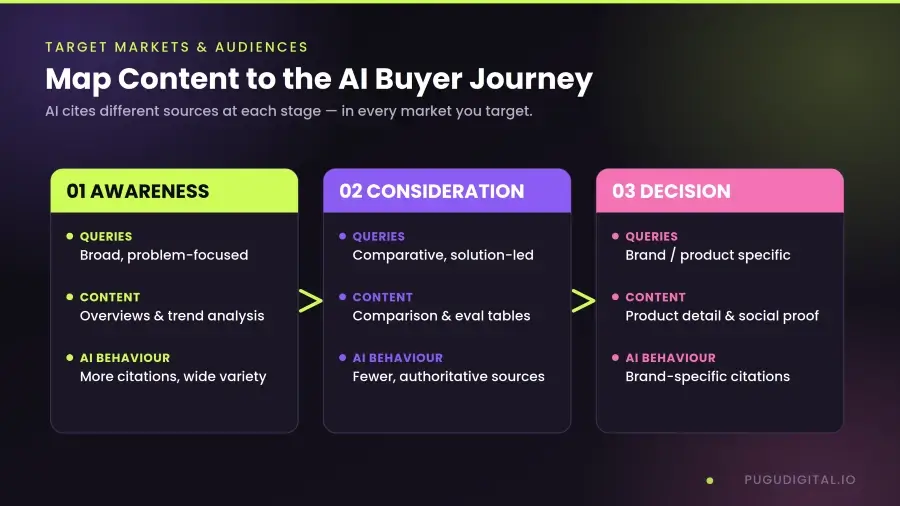
What triggers customers to begin AI-assisted research reveals visibility opportunities:
- What problems trigger research in your category in different regions?
- What events cause prospects to seek solutions?
- Where do customers drop off or shift to competitors in AI responses?
- Which journey stages have content gaps that leave visibility opportunities unclaimed?
Begin with mapping current content to awareness, consideration, and decision stages for each target market. Identify gaps where you lack visibility at specific stages. Analyze competitor visibility at stages where you’re absent and prioritize development for high-effect gaps.
Research Local and International Competitor Strategies
How competitors use GEO for local and International markets gives you understanding for your own strategy. Identify local competitors in each target market and analyze their online presence. Get into their Google My Business profiles, websites for local SEO practices, and customer reviews and ratings.
Test both category searches and branded questions in AI platforms. Check visibility for queries like “top [product type] platforms in [city]” and branded questions such as “what does [competitor] do” or “how does [product] compare to [your brand]”. Their content structure and authority signals provide a roadmap if competitors appear while you remain absent.
Set Clear Goals and Success Metrics
What to remember is that GEO isn’t a technical project but a business initiative. Disconnecting AI visibility from revenue metrics leads to optimization without accountability. Define success metrics that matter to your executive team:
- Pipeline contribution measuring what percentage of SQLs come from AI-sourced traffic.
- Conversion rate differential showing how AI traffic converts versus other channels.
- Customer acquisition cost comparing GEO effects to traditional SEO.
- Sales velocity tracking whether AI-sourced leads move faster through the pipeline.
Benchmark data provides context for business cases. B2B SaaS companies see average CAC of USD 249.00, pipeline velocity 40% faster, SQL attribution reaching 32% from AI platforms within six weeks, and citation increases of 300% within 90 days for B2B SaaS.
Your audit data from the visibility assessment provides evidence to make the case if leadership hasn’t prioritized this yet.
Step-by-Step Guide to Implementing GEO for Local and International Markets
Your audit is complete and goals are defined. You can now begin the work of making your content discoverable and citable on AI platforms that serve local and international markets. The following six steps provide a systematic approach to GEO for local and International markets that builds authority and visibility.
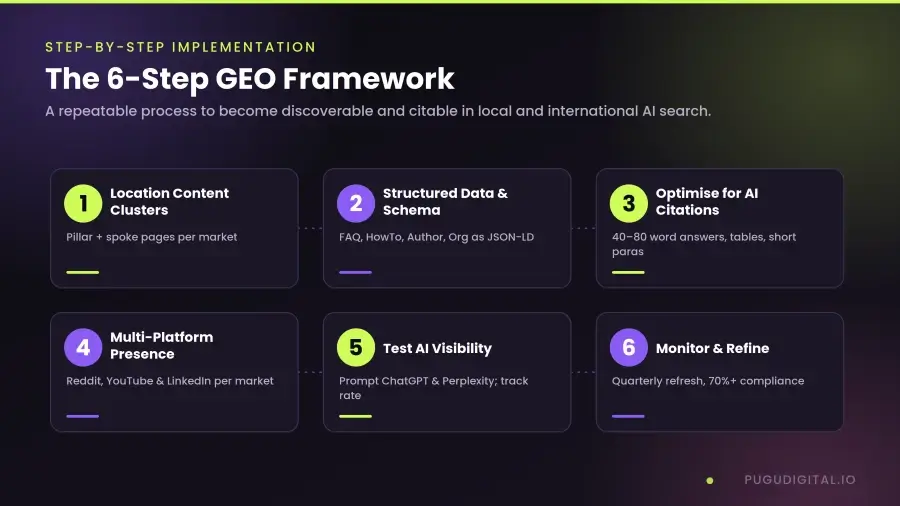
Step 1: Create Location-Specific Content Clusters
Organize your content like interconnected modules where each topic cluster becomes a knowledge hub. Build topic clusters around your core expertise areas for each target market. Each hub needs a central pillar page that provides a complete overview of a concept and links to detailed spoke pages covering specific sub-topics.
Your internal linking structure proves vital here. Use descriptive anchor text that defines the relationship between pages and reinforces connections between entities. This makes it easy for AI to recognize you as the complete authority. A simple structure isolates concerns and connects them through descriptive anchors. This lowers cognitive load for readers and large language models.
Step 2: Implement Structured Data and Schema Markup
Schema markup functions as explicit translation for AI systems. Going beyond Article or Organization schema proves non-negotiable for effective GEO for local and International markets optimization. Identify core entities for each page and select granular schema types from Schema.org. Use HowTo schema for how-to guides. Use FAQPage schema for Q&A pages. Schema markup appears in over 75% of high-performing GEO optimized pages.
Priority implementation includes FAQPage schema that feeds Q&A to AI systems, HowTo schema that matches process queries, Author schema that strengthens expertise signals, and Organization schema that improves brand entity recognition. Add structured data as JSON-LD in your page header. Validate using Google’s Rich Results Test.
Step 3: Optimize Content for AI Citations
AI systems reward clarity over keyword density. Reformat pages to improve extractability and make it effortless for AI to lift your insights and cite them. Open every page with a 40-80 word quick answer that addresses the core query. Then expand with context. Structure H2s as questions that mirror real user searches.
Content with quotes and statistics shows 30% to 40% higher visibility in AI responses. Format for machine parsing by using clear header hierarchy and limiting paragraphs to under 120 words. Incorporate numbered processes and build comparison tables AI can extract. Brands that use comparison tables and answer tables see up to 35% higher extractability and citation rates.
Step 4: Build Multi-Platform Presence for Each Market
Platforms that allow user-generated content appear to have high exposure in generative engines. Identify three to five platforms where your audience stays active in each market. Tailor content to fit each platform’s style and maintain consistent posting schedules. Encourage your audience to share experiences through campaigns like hashtag challenges or reviews.
Feature the best user-generated content on your platforms. Brand presence on Reddit, YouTube, and LinkedIn could prove important for visibility. Unlinked brand mentions seem to carry more weight with AI systems.
Step 5: Test Your AI Visibility in Different Markets
Query AI platforms with searches relevant to your business in target regions. Test extraction, for example in Perplexity and ChatGPT. Refine wording until your page gets cited. Track your AI citation rate by dividing citations by total answers in your sample window.
To name just one example, 99.5% of AI Overview citations now match one or more of the top 10 Google search results. A complete strategy tests on all platforms and identifies platform-specific patterns.
Step 6: Monitor and Refine Your Strategy
Treat GEO like any iterative practice: automated and monitored. Track pages that meet at least eight checklist items by dividing them by total audited pages. Target 70% compliance or higher.
Make last-updated dates visible and refresh high-value pages quarterly. Set up automated checks when content changes. Create tickets for citation rate drops. Regular updates signal to search engines that information stays current and relevant.
GEO Strategies for International Markets (Only)
GEO for International markets demands fundamentally different infrastructure than local strategies. Traditional approaches focused on translation and adaptation, but generative AI optimization for international markets now centers on entity architecture, concept governance, and retrieval optimization rather than page-level localization.
Organizations must design clear entity hierarchies that AI systems interpret correctly. Moreover, define how global entities relate to regional entities and how authority flows across geographic boundaries. Three citation strategies improve international visibility:
- Citations from credible sources
- relevant quotations
- statistical data
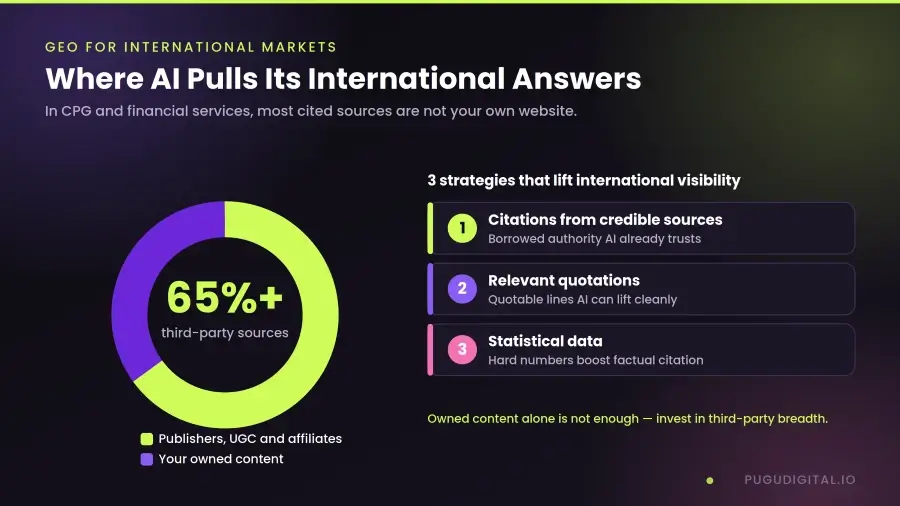
These improve website prominence and need minimal content changes, yet substantially boost how often AI platforms reference your brand in markets of all types. The effectiveness varies by domain:
- Authoritative language works best for historical content.
- Citation optimization proves most effective for factual queries.
Third-party content shapes the majority of international AI responses. Consumer-packaged goods and financial services see more than 65% of sources across AI-powered searches come from publishers, user-generated content, and affiliate sites. This reality means adjusting investments into owned content alone proves insufficient.
You need structured strategies for content breadth that AI-powered search answers draw from and should include third-party publishers and communities.
GEO for Local and International Markets Conclusion
You now have a roadmap to implement GEO for local and International markets in every region you serve. The move from traditional search to AI-generated answers creates challenges but also opens opportunities for businesses willing to adapt their approach.
Begin with the audit we outlined and work through each implementation step. Build structured, citable content that generative platforms trust and reference. Results won’t appear overnight, but your visibility will grow as you establish authority signals in local and international markets.
The brands winning in AI search are the ones taking action right now. Your competitors are already implementing these strategies, so start today and monitor your progress closely. Here at Pugu Digital we have a deep understanding of Generative Engine Optimization and started early on to understand it.
GEO for Local and International Markets FAQs
What is the main difference between GEO for local and International markets?
GEO for local and International markets share the same goal — earning citations in AI-generated responses. Nonetheless, they require different infrastructure. Local GEO leans on proximity-based trust signals: a consistent Google Business Profile, accurate NAP information, location-specific content clusters, and reviews that mention specific services tied to a place. The focus is helping AI systems confidently recommend you within a defined geographic area.
International GEO works at a different level. Rather than translating and localizing pages market by market, it centers on entity architecture, concept governance, and retrieval optimization. You design clear entity hierarchies that define how global entities relate to regional ones and how authority flows across borders, then reinforce visibility through credible citations, relevant quotations, and statistical data that travel well across markets.
Does traditional local SEO still matter for GEO, or do AI platforms use completely different signals?
Local SEO fundamentals remain important for GEO because AI platforms pull from many of the same sources as traditional search engines. Strong Google Business Profiles, consistent NAP (Name, Address, Phone) information, quality reviews, local citations, and authoritative directory listings, all contribute to AI visibility.
However, the weighting and interpretation differ—AI systems prioritize entity clarity, semantic context in reviews, and trust signals across multiple sources rather than just proximity and keyword matching.
How can local businesses measure their GEO performance when there aren’t clear rankings like traditional SEO?
Measuring GEO success requires tracking different metrics than traditional SEO rankings. Monitor AI citation frequency by testing relevant queries across platforms like ChatGPT, Perplexity, and Google AI Overviews to see if your business appears in responses.
Track branded search volume increases, direct traffic spikes following AI mentions, and use self-reported attribution by asking new customers how they discovered you. Some specialized tools now track AI visibility and citation rates, though the measurement landscape is still evolving.
What content strategies work best for getting cited in AI-generated local recommendations?
Create location-specific content that directly answers conversational questions users ask AI platforms. Use clear header structures with question-based H2 tags, provide concise answers in the first 40-80 words, and include detailed information about services tied to specific locations.
Encourage reviews that mention specific services and location details rather than generic praise. Implement structured data like LocalBusiness schema and maintain consistent entity information across all platforms to help AI systems confidently understand and recommend your business.
Which online platforms and directories matter most for local GEO visibility?
AI platforms heavily reference authoritative directories, review sites, and user-generated content platforms when making local recommendations. For local businesses, prioritize Google Business Profile, industry-specific directories (like Avvo for lawyers or Yelp for restaurants), and platforms with active user discussions like Reddit.
Consistent presence across trusted sources matters more than volume—AI systems look for verification and consensus across multiple authoritative platforms before confidently recommending a business.
How does GEO differ between individual professionals and business entities for local services?
AI platforms treat individual professionals and business entities differently when generating recommendations. Research shows that Perplexity recommends individuals by name approximately 78% of the time, while ChatGPT recommends firms about 64% of the time.
For professional services like law, or healthcare, optimize both the business entity and individual practitioner profiles with clear expertise markers, professional certifications, and consistent information across platforms to maximize visibility across different AI systems.