
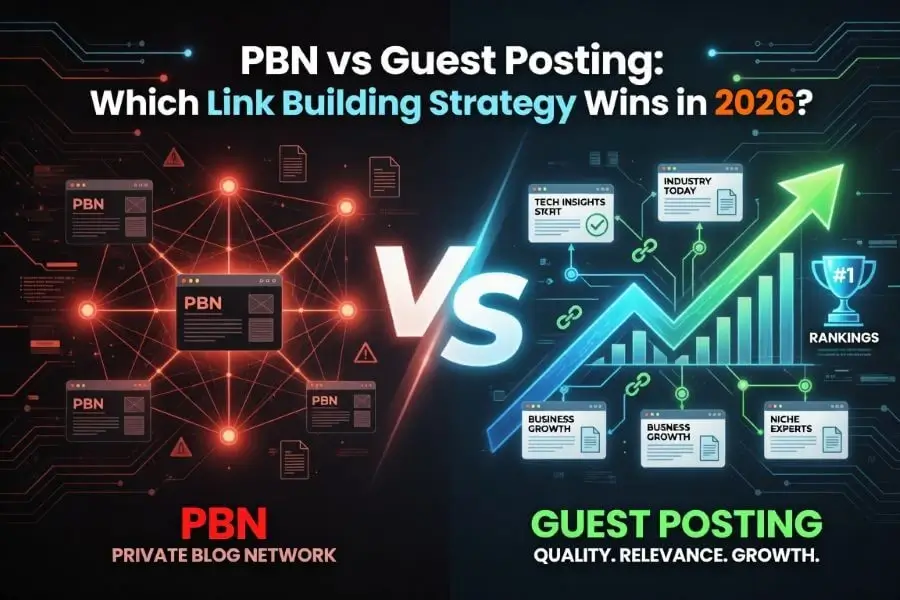
The PBN vs guest posting debate continues to divide SEO professionals in 2026, and picking the wrong strategy can cost you dearly. Private Blog Networks promise control and scalability. Guest posting offers organic link building through editorial placements. Both approaches have passionate advocates.
But which one actually delivers sustainable results without exposing you to Google link scheme penalties?
Drawing on more than a decade of SEO experience, I’ll break down the real costs, risks, and performance metrics to help you figure out which link building strategy makes sense for your situation in 2026.
PBN vs Guest Posting: Key Takeaways
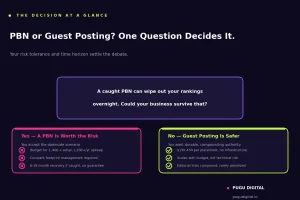
The PBN vs guest posting debate really comes down to one thing: risk versus sustainability. Private Blog Networks give you control, yes, but they violate Google’s policies and put your entire site at risk. Guest posting through legitimate publishers builds lasting authority without that existential threat hanging over your head.
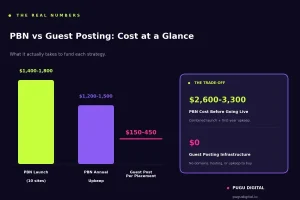
- PBNs cost USD 1,400-1,800 upfront for 10 sites plus USD 1,200-1,500 annually, while guest posts average USD 150-450 per placement with no infrastructure burden or ongoing maintenance requirements.
- Google issues 400,000+ monthly manual penalties for unnatural links (a decade-old statistic and no new figures have been published), with PBNs facing high detection risk requiring constant footprint elimination across IPs, hosting, and technical configurations.
- Guest posting scales easily through budget allocation without increasing risk, while expanding PBN networks can in some cases increase penalty exposure and management complexity across multiple properties.
- Editorial links from legitimate publishers compound permanently (in most cases), whereas PBN authority gets discounted by Google’s quality assessment and risks complete deindexing during algorithm updates.
- Recovery from PBN penalties is slow and difficult, often taking 6-18 months with no guarantee of returning to prior rankings, while legitimate guest posts rarely face penalties and build sustainable long-term rankings.
The fundamental choice here isn’t about which strategy costs less. It’s about whether you’re building a business for the long term or gambling with manipulative tactics that industry experts like Rand Fishkin explicitly warn against for anyone making a serious business investment.
What is Owning a Private Blog Network in 2026?
A private blog network is a collection of websites under single ownership, built specifically to generate backlinks pointing toward a main “money” site. PBN ownership means controlling every aspect of the link — from anchor text selection to the content surrounding it. This is fundamentally different from earning links through blogger outreach or editorial placements.
The whole system runs on acquiring expired domains that already carry established authority and backlink profiles, then repurposing them as link sources within a controlled network. However, Google’s SpamBrain system, rolled out in its 2022 Link Spam Update, is specifically designed to identify manufactured link networks that used to pass as editorial content.
Glenn Gabe, who has spent two decades diagnosing algorithm penalties, has documented cases of sites losing rankings virtually overnight after relying on manufactured link networks — a risk that sits at the center of the PBN vs guest posting decision.
How PBN Ownership Works: Building vs. Buying Expired Domains
Expired domain acquisition is the foundation of any PBN, delivering backlinks and authority that would take years to build organically. Topical relevance matters most — a health-related domain outperforms a generic one with similar metrics.
Two paths exist:
- Monitor auctions and marketplace alerts for aged domains yourself.
- Buy pre-vetted domains through specialized services at a premium.
Either way, domain selection requires examining authority metrics, backlink profiles, and historical content through tools that assess Trust Flow, Citation Flow, and referring domain counts.
Initial Setup Costs: Domain Registration and Hosting Infrastructure
Basic expired domains cost USD 10-15, while higher-tier domains with clean metrics run USD 100-400+. A 10-site PBN costs roughly USD 1,400-1,800 to launch, plus USD 1,200-1,500 annually. A commitment that makes the PBN vs guest posting cost comparison worth running before you commit.
Hosting adds another 20-30% buffer, averaging USD 3 per domain, reaching USD 500 upfront and USD 200 annually.
Content Creation and Management Requirements
Quality content is what keeps PBN sites looking legitimate. Each piece needs to reflect genuine expertise while maintaining distinct characteristics across network properties. Content creation typically runs USD 10-20 per 500 words (if doing it yourself and using AI). Hiring an agency, the price increases substantially.
Sites need initial anchor articles and then regular updates — without them, properties start looking dormant, which raises red flags.
Footprint Detection: Technical Considerations for Network Concealment
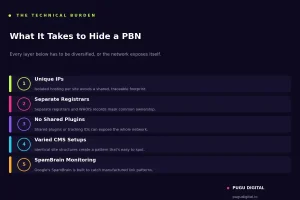
Maintaining network anonymity means eliminating footprints across every technical layer. Each site needs its own IP, unique theme and CMS setup, separate analytics, and a distinct registrar. Ideally in different countries.
Technical isolation also means avoiding shared plugins, matching tracking IDs, and common nameservers. Any overlap can expose the entire network to Google’s detection systems, and the burden only grows as the network scales.
What is Guest Posting Outreach?
Guest posting is a link building approach where brands contribute articles to third-party websites in exchange for contextual backlinks. Unlike PBN ownership, this method is built on relationships with legitimate publishers: earning placements through genuine value exchange rather than network manipulation.
Guest posts can also be transactional, meaning you pay a publisher to post and link back to your site. Google’s guidelines prohibit paid links that pass ranking credit without disclosure, so any paid placement needs a “sponsored” or “nofollow” tag to stay compliant — at Pugu Digital, we run both organic and paid placements this way, always disclosed and fully compliant.
Content responsibility varies within blogger outreach more broadly: with guest posting, you write and supply the article yourself, while other outreach formats have the publisher create content around a brand mention or link.
The Blogger Outreach Process: Finding and Vetting Publishers
Identify niche-relevant sites using “write for us” searches, competitor backlink analysis, and contributor platforms. DA 30+ is the baseline, DA 50+ ideal, though niche relevance often outweighs raw authority. Organic traffic validates trust better than metrics alone. Check for:
- Spam score above 5% — automatic rejection.
- Organic vs. artificial backlink history.
- Red flags like link spikes or exact-match anchor overuse.
Cost Per Link: Industry Pricing for Editorial Placements
Guest post pricing typically runs USD 150-450 per placement depending on quality tier, with link insertions averaging less. This is where the PBN vs guest posting cost comparison gets interesting — no upfront domain or hosting investment required, unlike a PBN’s USD 1,400-1,800 launch cost. Pricing patterns worth knowing:
- Each additional 10 DR points adds roughly 32% to the price.
- 10K-traffic sites charge ~21% more than 1K-traffic sites.
- Core English-speaking markets run ~50% above global averages.
Link Acquisition Timeline: From Pitch to Publication
Most campaigns take several weeks from pitch to publication as publishers review submissions, approve topics, and schedule content — a natural byproduct of real editorial processes, not a strategy flaw.
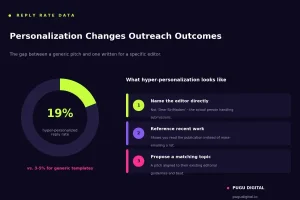
Personalization changes outcomes dramatically: hyper-personalized outreach achieves roughly 19% reply rates versus just 3-5% for generic templates. Successful pitches name the editor, reference their recent work, and propose topics matching their guidelines.
Quality Signals: Domain Authority and Niche Relevance Factors
Niche relevance drives real contextual value. Search algorithms understand topical connections, so a backlink from a site in your actual industry outweighs a placement on a completely unrelated site, even with matching authority scores.
Genuine audience engagement matters too: active comments and real social shares signal actual readership, not a hollow authority shell built purely to pass SEO metrics.
Investment Comparison: PBN Ownership vs Guest Posting
The financial models here are fundamentally different, and that distinction matters more than most SEO practitioners realize. PBN ownership concentrates capital upfront with recurring operational costs that never stop. Guest posting spreads spend across individual placements, with no infrastructure to maintain and no sunk costs sitting on a server somewhere.
Upfront Capital Requirements and Ongoing Maintenance
A 10-site PBN costs USD 1,400-1,800 to launch and USD 1,200-1,500 annually to maintain — roughly USD 140-180 per site upfront, plus USD 120 a year in ongoing costs. Domain quality drives most of the variance:
- Basic expired domains: USD 20-50.
- Auction domains with stronger backlink profiles: USD 100-200+.
- Premium domains with clean authority histories: often thousands.
- Hosting: USD 200-400/year for 10 sites (USD 2-10/month per site).
- Content: USD 10-50 per article, with regular updates required to stay looking legitimate.
Guest posting carries no infrastructure to own or maintain. Pricing scales with site quality instead of network size:
- Average placement: USD 150-450.
- Each additional 10 DR points adds roughly 32% to cost.
- Sites with 10K+ monthly traffic charge ~21% more than lower-traffic properties.
Time Investment: Managing It Yourself vs. Outsourcing
PBNs don’t just cost money. They cost time. Every site in the network requires ongoing updates, technical monitoring, and security maintenance. When a network site gets discovered, replacing those links adds another unexpected time drain on top of everything else.
Guest posting through agencies like Pugu Digital, on the other hand, offloads that burden entirely — including the content writing services needed to actually produce placement-ready articles. White-label link building agencies run USD 3,000-10,000 monthly, and full-time in-house SEO specialists cost USD 60,000-120,000 annually before you factor in tooling. That’s not cheap, but agencies bring established publisher relationships and operational systems that would take years to build independently.
Scalability: Where the Two Models Diverge
A small PBN that manages three to five sites might stay under the radar for a while. Scale to dozens of sites, and the risk increases exponentially. More domains mean more hosting accounts, more content to maintain, and more footprints converging on the same target sites. The pattern becomes harder to hide the bigger it gets.
Guest posting has no such ceiling. Volume goes up or down based on budget, not infrastructure capacity. Agencies handle the operational side, so scaling doesn’t require hiring additional staff or managing additional properties.
Hidden Costs Worth Accounting For
The real cost of a PBN failure doesn’t show up in your hosting invoice. When rankings drop from a penalty, lost revenue compounds quickly. Penalty cleanup and link removal efforts carry their own costs. And the time spent managing technical problems across multiple network properties is time not spent building legitimate authority.
Plugin updates, security patches, and preventing sites from getting hacked become ongoing management tasks multiplied across every site in the network. That overhead doesn’t get smaller as the network grows, as it scales right alongside it. Hence, if you plan to build sustainable site authority, guest posting is in the long run the cheapest and safest method.
Performance Metrics: Link Equity and Keyword Rankings in 2026
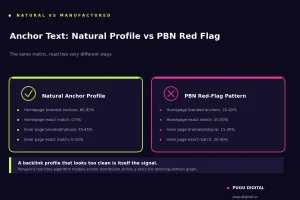
Complete anchor text control is often cited as the defining PBN advantage over guest posting — you choose exactly what text points to your money site. That precision is also the giveaway.
Natural anchor profiles are messy by design: a healthy mix of branded terms, naked URLs, generic phrases (“click here,” “read more”), and only a small fraction of exact-match keywords. Homepages typically carry 80-95% branded anchors, inner pages 35-45%, with exact-match staying under 5% and 10% respectively. Penguin’s real-time algorithm specifically models this distribution across a site’s full referring-domain graph — not link-by-link, but in aggregate.
A PBN vs guest posting comparison exposes the flaw in owning the network: concentrated control over a small set of domains makes it statistically easy to over-index on money keywords, producing an anchor ratio no organically earned profile would ever replicate. That imbalance, not any single link, is what gets flagged.
PBN vs Guest Posting: Side-by-Side Comparison
The sections above cover costs, risks, and ranking performance in detail. Sometimes, though, it helps to see everything laid out in one place. The table below puts both strategies head-to-head across the dimensions that matter most—from upfront investment and penalty exposure to scalability and long-term sustainability.
| Attribute | PBN (Private Blog Network) | Guest Posting |
|---|---|---|
| Initial Setup Cost | USD 1,400-1,800 for 10-site network | No upfront infrastructure cost |
| Cost Per Site/Link | USD 140-180 per site (one-time) + USD 120/year maintenance | USD 150-450 per guest post (average) |
| Domain Acquisition | USD 10-50 (basic) to USD 100-400+ (quality expired domains) | Not applicable |
| Hosting Costs | USD 200-400 annually for 10-site network (USD 2-10/month per site) | Not applicable |
| Content Creation | USD 10-50 per article; ongoing updates required | Included in placement cost |
| Annual Maintenance (10 sites) | USD 1,200-1,500 | Not applicable |
| Time Investment | High — constant monitoring, updates, security maintenance across multiple sites | Low — outsourced to agencies or publishers |
| Management Complexity | Multiple websites requiring technical monitoring, plugin updates, security | Single relationship per placement |
| Scalability | Difficult — each additional site multiplies risk and footprint detection | Easy — scales through budget allocation without infrastructure |
| Anchor Text Control | Complete control over anchor text selection | Limited — subject to editorial guidelines |
| Link Quality | Manipulated placements from expired domains with borrowed authority | Editorial links from legitimate publishers with real audiences |
| Niche Relevance | Controllable but requires acquiring topically relevant expired domains | High — placements on genuine industry publications |
| Google Penalty Risk | High — violates Google’s link scheme policies; subject to manual actions and algorithmic devaluation | Low — when done through legitimate publishers with editorial standards |
| Detection Risk | High — requires eliminating footprints (unique IPs, different hosts, varied WHOIS, distinct CMS) | Minimal — legitimate editorial placements |
| Manual Penalty Rate | Historically cited at 400,000+ monthly (Google, ~2014); no updated figures published since | Rare when following editorial guidelines |
| Algorithmic Devaluation | High risk — Penguin update specifically targets manipulative link tactics | Low — editorial links align with quality standards |
| Recovery Difficulty | Extremely difficult — link removal, disavowing, and reconsideration requests, often taking 6-18 months with no guarantee of full recovery | Minimal — legitimate links rarely penalized |
| Penalty Notification | Manual actions appear in Search Console; algorithmic penalties have no notification | Not applicable for legitimate placements |
| Long-term Sustainability | Unsustainable — “not recommended for anyone making a long-term bet on their business” (Rand Fishkin) | Sustainable — builds compounding authority permanently |
| Hidden Costs | Lost revenue from ranking drops, penalty cleanup, opportunity costs, security monitoring | Minimal beyond placement costs |
| Link Velocity Concerns | Sudden spikes trigger spam detection; network growth creates obvious patterns | Natural distribution through editorial calendar |
| Domain Authority Impact | Borrowed authority from expired domains; discounted by Google’s quality assessment | Genuine authority from active, trusted publications |
| Traffic Quality | No referral traffic from dormant network sites | Real referral traffic from sites with organic visitors |
| Recommended Anchor Distribution | Requires careful management: 80-95% branded for homepages, max 5-10% exact match | Natural distribution follows editorial context |
| Agency/Service Costs | Self-managed or specialized PBN services | USD 3,000-10,000 monthly for white-label agencies |
| In-house Resource Cost | Full-time management across network sites | USD 60,000-120,000 annually for in-house SEO specialist |
| Pricing Factors | Domain quality, backlink profile, topical relevance | Each 10 DR points adds ~32%; 10K traffic sites cost ~21% more |
| Geographic Pricing | Hosting diversification across countries required | Core English markets cost ~50% more than global average |
| Outreach Success Rate | Not applicable | 19% reply rate for hyper-personalized outreach vs 3-5% for generic templates |
| Publication Timeline | Immediate — full control over publishing | Several weeks from pitch to publication |
| Editorial Standards | Self-determined; risk of thin content | Subject to publisher guidelines and review processes |
| Spam Score Threshold | Network sites may accumulate spam signals | Reject prospects with spam score above 5% |
| Best Use Case | Not recommended due to severe penalty risk | Sustainable long-term authority building through legitimate editorial relationships |
The numbers tell part of the story. The risk profile tells the rest.
What We Learned: PBN vs Guest Posting
The PBN vs guest posting decision ultimately comes down to risk tolerance and business longevity. PBNs deliver control and scalability but expose you to severe Google penalties that can destroy years of ranking progress. Guest posting builds sustainable authority through legitimate editorial relationships that compound permanently.
After more than a decade running SEO campaigns at Pugu Digital, I’ve watched countless PBN operators lose everything during algorithm updates. Editorial placements consistently outperform manipulated networks over extended timeframes.
Ready to build a link building strategy that actually holds up over time? Contact our team for a free consultation, and we’ll help you develop an approach that protects your rankings and delivers measurable growth without the penalty exposure.
PBN vs Guest Posting FAQs
What are the main differences between PBNs and guest posting for link building?
PBNs involve owning a network of websites specifically built to create backlinks to your main site, giving you complete control over anchor text and placement. Guest posting means contributing content or paid placement to third-party websites you don’t own in exchange for editorial links. The key difference lies in ownership and risk: PBNs violate Google’s guidelines and carry high penalty risk, while guest posting on legitimate sites builds sustainable authority through natural editorial relationships.
How much does it cost to build and maintain a PBN compared to guest posting?
The PBN vs guest posting cost comparison starts with upfront investment. Building a 10-site PBN requires USD 1,400-1,800 upfront plus USD 1,200-1,500 annually for maintenance, including domain acquisition, hosting, and content creation. Guest posting operates on a per-placement model with no infrastructure costs, averaging USD 150-450 per post for standard placements and USD 650-1,000 for high-quality editorial placements. While PBNs demand significant capital concentration upfront, guest posting distributes costs across individual placements without ownership obligations.
What are the penalty risks associated with using PBNs?
PBNs carry severe penalty risks because they violate Google’s link scheme policies. Google issues manual penalties monthly for unnatural links, and algorithmic updates like Penguin specifically target manipulative link tactics. Penalties can range from ranking suppression to complete deindexing from search results. Recovery is extremely difficult, requiring link removal, disavowing, and reconsideration requests with no guarantee of success. This is the core risk driving the PBN vs guest posting decision. Hence, the long-term exposure makes PBNs unsuitable for sustainable growth.
Which link building strategy, PBN vs guest posting, works better in 2026?
In the PBN vs guest posting debate, guest posting through legitimate editorial placements consistently comes out ahead for sustainable growth in 2026. Editorial links from real publications with active audiences and organic traffic carry significantly more weight than manipulated placements from expired domains. While PBNs offer short-term control, they expose you to severe penalties that can destroy years of ranking progress. Quality guest posts build compounding authority that lasts permanently without penalty exposure.
Can you still use guest posting effectively without it being considered spam?
Yes, guest posting remains effective when done through legitimate publishers with editorial standards. Focus on targeted placements on relevant sites with real traffic rather than mass submissions. Hyper-personalized outreach achieves 19% reply rates versus 3-5% for generic templates. The key is providing genuine value to the host’s audience while earning contextual backlinks naturally. Avoid low-quality, paid-for posts aimed solely at link manipulation, and prioritize building relationships with reputable sites in your niche.