

Search intent optimization helps you create content that actually serves user needs. Understanding what searchers really want is more important than matching keywords perfectly.
With the right intent, search engines reward with better rankings and higher conversions. They want to see satisfied users who find exactly what they’re looking for.
When you nail the intent behind a search, people stay longer, engage more, and convert better.
Here’s what you need to focus on:
- Study the SERP before writing anything – look at what type of content ranks and what features Google shows.
- Match your content type to user expectations – informational queries need guides, transactional searches need product pages.
- Write for AI systems with clear headings and direct answers that can be easily extracted.
- Monitor user behavior signals like bounce rate and time on page to spot when intent shifts.
- Target natural language queries as voice search and conversational AI change how people search.
This guide will show you how to identify what searchers really want and create content that delivers exactly that. I’ll cover the different types of search intent, how to spot them for your keywords, and the specific techniques that work best for each type.
Understanding Search Intent and Why it Matters More Than Ever
Every search query carries a purpose. Search intent represents that underlying goal – the reason someone searches rather than just the keywords they type. Someone might need an answer, want to find a specific website, compare products, or get ready to buy something. Search engine platforms work hard to decode this motivation because showing the wrong type of result means failing users completely.
Google’s algorithms have moved far beyond simple keyword matching. They now focus on semantic understanding – what queries actually mean, not just which words appear on a page.
This allows search engines to interpret natural language patterns, analyzing context across entire sentences instead of isolated terms. Modern AI systems bridge the gap between what users type and what they really want to find.
This shift matters because relevance drives rankings more than any other factor. Google’s Search Quality Evaluator Guidelines reference user intent extensively, showing how seriously the company treats this concept. The algorithm studies top-ranking pages to identify dominant intent patterns, then prioritizes content that matches those expectations.
When you match intent correctly, users stay longer, engage more, and convert at higher rates. That positive behavior signals quality to search engines, which reinforces your rankings. Miss the mark, though, and you’ll see high bounce rates and declining visibility.
Four Types of Search Intent That Drive Rankings
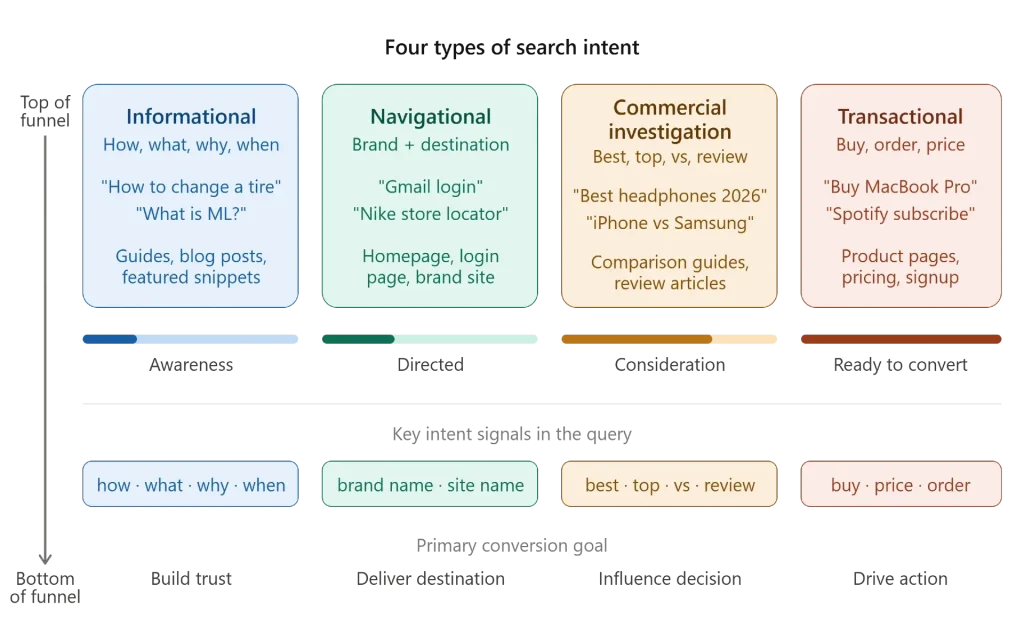
Search intent breaks down into four main categories. Each one requires a different approach to content creation and Search Engine optimization.
Informational Intent
People with informational intent want answers or knowledge. They’re not looking to buy anything yet. These searches often start with “how,” “what,” “why,” or “when.”
Someone searching “how to change a tire” or “what is machine learning” just wants to learn something. Google typically shows blog posts, guides, or videos for these queries. Featured snippets appear frequently because users want quick answers.
This intent sits at the top of the marketing funnel. You’re building awareness, not driving immediate conversions.
Navigational Intent
Navigational searches happen when people want to reach a specific website or page. They already know where they’re going and use Google as a shortcut.
Examples include “Gmail login,” “Pugu Digital homepage,” or “Nike store locator.” These queries usually include brand names or specific product names.
People typing these searches have a strong intent to visit that particular destination.
Commercial Investigation Intent
This intent falls between research and purchase. Users know they want to buy something, but haven’t decided what or where yet.
These searches include modifiers like “best,” “top,” “review,” “vs,” or “comparison.” Someone searching “best wireless headphones 2026” or “iPhone vs Samsung” is actively comparing options. They’re close to making a purchase decision but need more information first.
Google often shows comparison articles, review sites, and buying guides for these queries.
Transactional Intent
Transactional searches signal immediate readiness to act. Users want to buy, subscribe, download, or complete a specific action right now.
These queries contain words like “buy,” “order,” “discount,” “price,” or “subscribe.” Someone searching “buy MacBook Pro” or “Spotify premium subscription” has finished their research and is ready to convert.
Product pages, pricing pages, and signup forms dominate these search results.
Avoid Mixed Intent Queries
Not every search fits neatly into one category. “Running shoes” could trigger both informational results (buying guides) and transactional results (product pages) on the same SERP.
When you see mixed results, it means Google detected multiple user intents for that keyword. Your content strategy should address the dominant intent while acknowledging secondary intents where appropriate.
How to Identify Search Intent for Your Keywords
Understanding intent categories is one thing. Actually identifying them for your specific keywords is where the real work happens. You need reliable methods to decode what users expect when they search for your target terms.
Analyze SERP Features and Ranking Pages
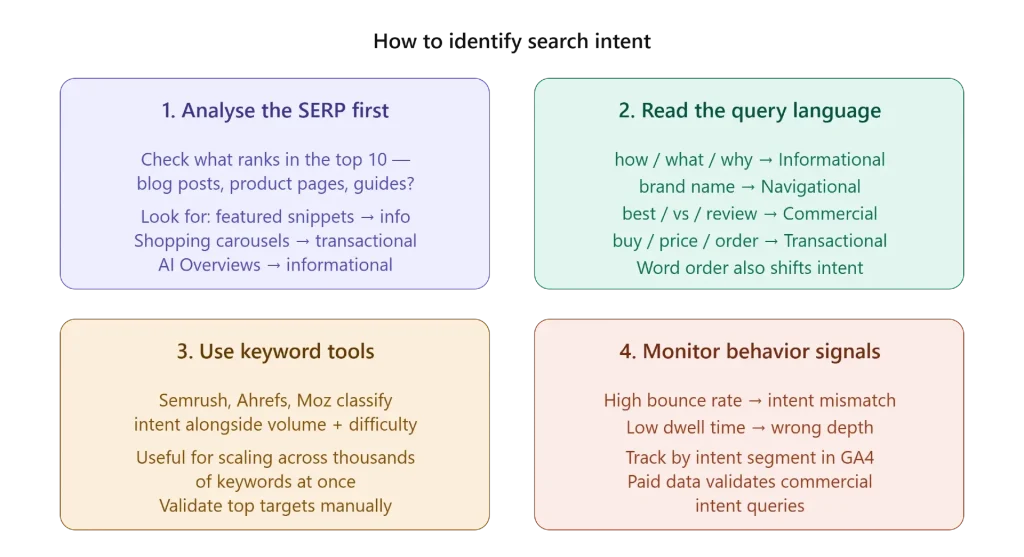
The SERP tells you exactly what Google thinks users want. Type your keyword into Google and study what ranks in the top ten positions. Look for patterns in content type – blog posts versus product pages, how-to guides versus listicles, beginner content versus expert-level material.
SERP features reveal user expectations instantly. Featured snippets typically signal informational search intent, while shopping carousels indicate transactional queries. People Also Ask boxes show related questions users want answered. Additionally, AI Overviews appear frequently for informational queries, particularly those starting with “what is” or “how to.”
Study Query Language and Keyword Modifiers
Query structure reveals intent immediately. Words like “how,” “what,” and “why” mark informational searches. “Best,” “top,” “review,” and “vs” signal commercial investigation intent. “Buy,” “discount,” “price,” and “order” indicate transactional queries. Brand names or product names suggest navigational intent.
Word order also matters more than you might think. “Content for gambling” differs from “gambling content” — the former suggests someone looking to produce it (an operator or dev searching for a supplier), while the latter signals someone researching the topic or landscape itself.
Use Search Intent Tools for Keyword Research
Semrush’s Keyword Magic Tool, Moz Pro, and Ahrefs automate intent classification at scale. These platforms analyze SERP data using machine learning and display intent labels alongside search volume and difficulty metrics. Semrush shows intent directly in the interface, allowing quick filtering by intent type. Moz AI powers intent detection in their Keyword Suggestions feature.
These tools save time when analyzing thousands of keywords, though manual SERP checks remain valuable for final validation.
Review User Behavior Signals and Engagement Metrics
Metrics like click-through rate, dwell time, bounce rate, and conversions confirm whether content matches user search intent. High bounce rates often indicate intent misalignment. Low time on page suggests users didn’t find the expected depth of information.
Track these metrics by intent segment in analytics platforms to identify which intent types drive pipeline and conversions. Paid campaign data paired with conversion rates validates which search intent queries bring commercial value.
How to Optimize Content for Search Intent
Getting search intent right requires a methodical approach. You can’t guess what users want and hope it works. Here’s how to align your content with what searchers actually expect to find.
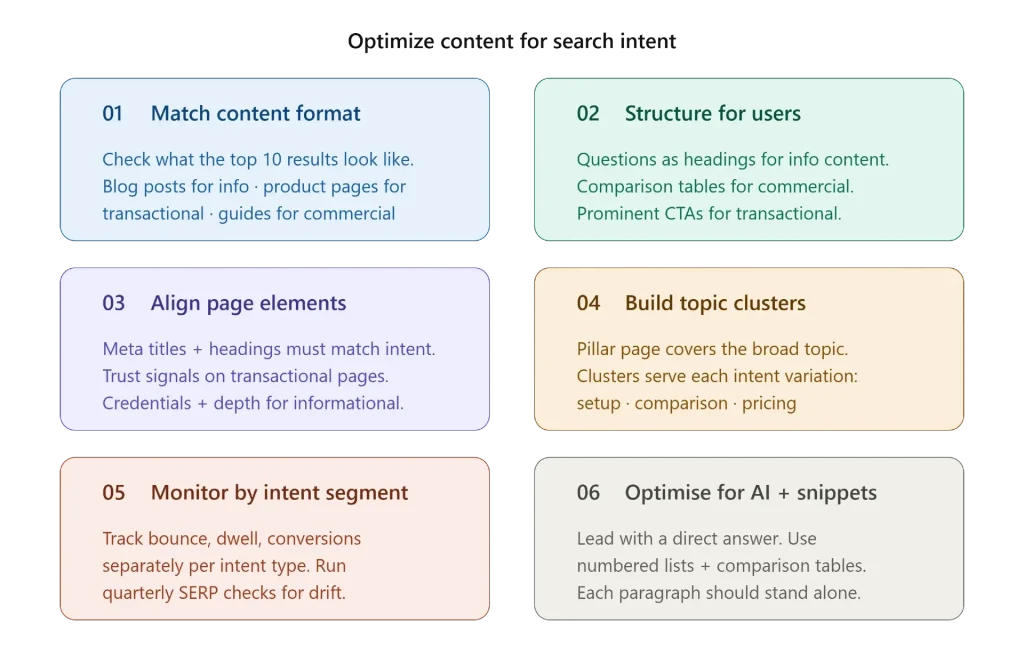
1. Match Content Format to What’s Already Ranking
Content format decides whether you rank or disappear. Look at the top ten results for your target keyword and notice patterns. Blog posts dominate informational queries. Product pages fill transactional searches. Comparison guides win commercial investigation keywords.
Don’t send someone ready to buy to a how-to guide, for example. That’s like directing a hungry person to a cookbook instead of a restaurant.
2. Structure Information the Way Users Think
Organize content to match how people process information for each intent type. Question-based headings work well for informational content. Comparison tables help commercial investigation searchers evaluate options. Prominent calls-to-action guide transactional visitors toward conversion.
Break complex topics into scannable sections. Most people skim before they read, especially on mobile devices.
3. Align Page Elements with Intent Signals
Your meta titles, descriptions, and headings must reflect the dominant intent. Include pricing and trust signals like reviews on transactional pages. Feature expert credentials and detailed explanations for informational content. Use language that mirrors how people actually search.
If someone searches “best iGaming SEO agency,” don’t optimize for “top-rated casino marketing services.”
4. Build Topic Clusters Around Intent Types
Create pillar pages covering broad topics, then link to cluster content addressing specific intent variations. This approach signals topical authority while serving users at different stages of their journey.
A pillar page about “email marketing” might link to clusters covering setup guides (informational), software comparisons (commercial investigation), and pricing pages (transactional).
5. Monitor Performance by Intent Segment
Track bounce rate, time on page, and conversions separately for each intent type. High bounce rates often signal misalignment between content and expectations. Strong engagement metrics confirm you’ve matched intent correctly.
Search intent shifts over time. Quarterly SERP checks help you spot when content formats change for your target keywords.
6. Optimize for Featured Snippets and AI Responses
Structure answers in clear, extractable blocks. Lead with direct responses in your opening sentences. Use numbered lists and comparison tables where they add value.
Featured snippets require standalone explanations that make sense when pulled out of context. Write as if each paragraph might appear by itself in search results.
Advanced Search Intent Optimization Techniques
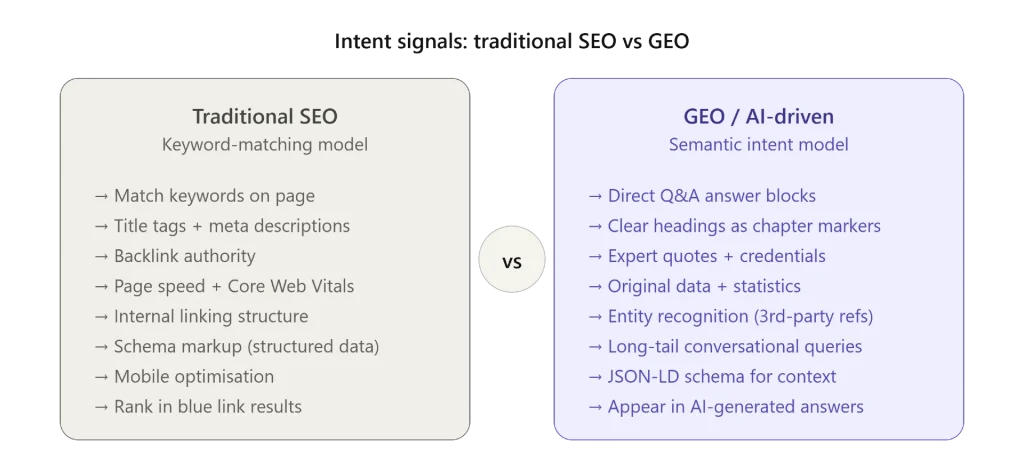
AI systems read content differently than traditional crawlers. Instead of processing pages from top to bottom, they extract headings, question-answer pairs, and structured lists as separate components. This shift changes how we should structure content for maximum visibility.
Clear, precise language works better than flowery descriptions. Simple punctuation helps AI parse sentence meaning more accurately than complex formatting. Facts and measurable data outperform vague statements when AI systems evaluate content authority.
Optimizing for AI Search Intent Signals
AI search referrals to top websites spiked by a significant margin year-over-year in June of the prior year. These systems favor fresh, authoritative content with clear semantic structure.
Headings function as chapter markers that AI systems use to slice content into digestible pieces.
Direct questions paired with immediate answers mirror natural search patterns, making it easier for AI to extract relevant information for responses. Schema markup provides additional context through JSON-LD format that most content management systems support.
The key difference is intent recognition. AI systems analyze content context beyond keyword matching, looking for signals that indicate whether a page truly answers the user’s underlying question.
Handling Multi-Intent and Long-Tail Keywords
Long-tail keywords naturally align with conversational AI queries. Google AI Mode uses query fan-out, expanding user searches into related sub-queries to gather comprehensive information. Target specific long-tail phrases to increase your chances of matching these expanded queries and appearing in AI responses.
Users now phrase searches as longer, natural prompts that often combine multiple intents. Someone searching “best budget laptops for college students under $500” demonstrates both commercial investigation and transactional intent. Create content that addresses multiple angles when targeting these complex queries.
The solution is building pages that serve multiple needs simultaneously. Structure sections to answer the informational aspects while including comparison data and purchase guidance.
GEO Optimization and Generative Search Intent
Generative Engine Optimization focuses on appearing in AI-generated answers rather than ranking in traditional search results. Generative search intent represents the top AI search intent category, covering queries where users request specific outputs like “create X” or “calculate Y”.
Structure content with scannable lists and clear hierarchies. Include expert quotes with credentials, original data, and verifiable statistics. Pages containing quotes and statistics show higher visibility in AI responses compared to content without supporting evidence.
Build entity recognition across authoritative third-party websites while maintaining consistent structured data signals. This creates a web of authority signals that AI systems can verify across multiple sources, increasing confidence in your content.
Reducing Bounce Rate Through Better Intent Alignment
Misaligned content creates immediate exit behavior. When search intent doesn’t match page content, bounce rates spike and search visibility drops.
Lead with your most valuable information. Answer the primary question in the opening paragraph before expanding into supporting details. Structure pages with clear heading hierarchy so users can quickly navigate to relevant sections.
Mobile optimization remains critical since mobile accounts for over half of web traffic. Poor mobile experience amplifies intent misalignment problems, creating double penalties for both user experience and search rankings.
Adapting to Evolving Search Behavior Patterns
Voice assistants and AI tools have shifted queries from fragmented keywords to full conversational questions. Users ask complete questions in natural language rather than typing abbreviated terms.
Content needs to reflect this conversational style. Structured data enables quick, accurate answers that match natural speech patterns. Videos, infographics, and podcasts now drive discovery across platforms beyond traditional search engines.
This evolution means rethinking content organization. Questions that users might ask should become section headings, with direct answers following immediately.
Search Intent Conclusion
You now have everything needed to master search intent optimization and rank higher on modern search engines. Start by analyzing your existing content against the dominant intent for each keyword. Fix misalignments, match content formats to user expectations, and adapt to AI-driven GEO search patterns. Search intent mastery takes practice, but the payoff is significant.
Or, if you liked this guide, Pugu Digital helps businesses build content strategies that match every stage of the buyer journey — from first search to final conversion.
Book your free consultation today and find out exactly where your current content is losing traffic and money.
FAQs for Search Intent Optimization
What is search intent and why does it matter for SEO?
Search intent represents the underlying purpose or goal behind a user’s search query—whether they want to learn something, find a specific website, compare products, or make a purchase. It matters because search engines now prioritize content that satisfies user intent over simple keyword matching. When your content aligns with what searchers actually need, you’ll see better rankings, lower bounce rates, and higher conversion rates.
What are the main types of search intent I should optimize for?
There are four core types: Informational intent (users seeking knowledge or answers), Navigational intent (users looking for a specific website or page), Commercial Investigation intent (users comparing options before buying), and Transactional intent (users ready to purchase or take action). Some queries also have mixed intent, requiring content that addresses multiple user goals simultaneously.
How can I identify the search intent behind my target keywords?
The fastest method is analyzing the search engine results page (SERP) for your keyword. Look at what type of content ranks in the top positions—blog posts indicate informational intent, while product pages suggest transactional intent. Also examine SERP features like featured snippets and shopping carousels. Additionally, study the language and modifiers in queries (words like “how,” “best,” or “buy”) and use SEO tools like Semrush or Ahrefs that automatically classify intent.
What’s the difference between optimizing for traditional search and AI-powered search?
AI systems parse content into modular pieces rather than reading sequentially, extracting headings, question-answer pairs, and structured lists as standalone units. For AI optimization, use clear language, direct answers to questions, structured data markup, and scannable formats. AI search also favors conversational, long-tail keywords that mirror natural language queries, and prioritizes content with expert quotes, statistics, and verifiable claims.
How do I know if my content matches search intent correctly?
Monitor user behavior metrics like bounce rate, time on page, and conversion rates. High bounce rates and low engagement typically signal intent misalignment, meaning users aren’t finding what they expected. Strong engagement, longer dwell time, and good conversion rates indicate your content successfully matches user expectations. Review these metrics quarterly and check if SERP patterns have shifted for your target keywords.