

Generative Engine Optimization refers to the practice of structuring and refining content so that AI-powered platforms cite, recommend, or mention your brand when users search for answers. You’re not competing for rankings on a search results page. You’re positioning your content to become part of the blended response that AI systems deliver to users.
Many experts are currently discussing how GEO will impact future SEO and current digital marketing practices, as the line between search and AI-generated answers continues to blur. Marketers who ignore this move now risk losing visibility later, where audiences find answers more often.
Platforms like ChatGPT, Perplexity AI, and Claude AI deliver AI-generated search results to users without intermediaries. Traditional SEO tactics alone won’t secure your brand’s presence in these answer engine optimization ecosystems. This fundamental change in search behavior demands a new approach to content strategy and digital marketing.
We’ll explore what GEO entails, how it is different from conventional search optimization, and the best practices to optimize for AI search engines. Pugu Digital brings professional expertise in GEO content marketing to help you guide through this progress and maintain a competitive advantage in the AI-driven search landscape.
What Is Generative Engine Optimization (GEO)?
The platforms driving this move include ChatGPT, Perplexity AI, Google AI Overviews, Claude, and Gemini. These systems don’t present lists of clickable links the way traditional search engines do. They generate single, combined answers by pulling information from multiple sources and combining them into coherent responses. If your content doesn’t appear in that answer, you remain invisible at the exact moment potential customers make decisions.
You might encounter other terms for this practice. Answer Engine Optimization (AEO), Artificial Intelligence Optimization (AIO), and Large Language Model Optimization (LLMO) all describe the same concept. Pugu Digital uses these terms interchangeably when developing GEO content marketing strategies for clients. We focus on the outcome rather than the label.
Retrieval-Augmented Generation
The mechanics behind AI-generated search results differ from traditional search. Most AI systems use Retrieval-Augmented Generation, a two-step process where platforms first retrieve relevant content from external sources, then generate answers based on what they found. The AI parses user intent and searches vector databases for relevant content chunks. It pulls specific passages from indexed sources, blends multiple sources into coherent responses, and attributes the sources it drew from.
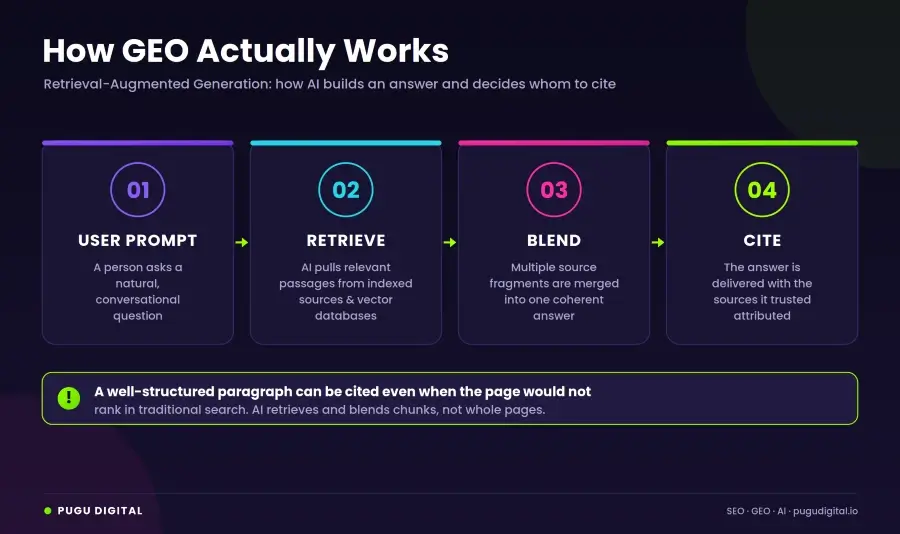
This process explains why a well-laid-out paragraph answering a specific question can get cited even when the page wouldn’t rank in traditional search results. AI systems retrieve and blend content fragments rather than ranking whole pages. Entity recognition matters a lot for this reason. The AI needs to understand your brand as a distinct entity with specific attributes.
AI Overviews Impact on Search Results
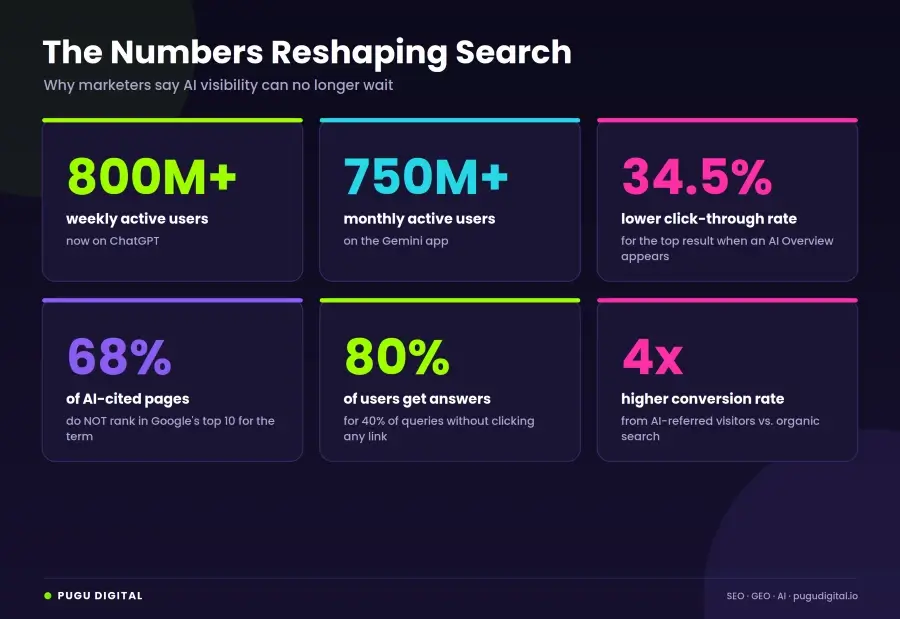
ChatGPT now reaches over eight hundred million weekly users. Google’s Gemini app has surpassed seven hundred fifty million monthly users. AI Overviews now appear at the top of searches often. What’s intersting is that top page results experience a thirty-four point five percent lower click-through rate than when an AI Overview appears compared to similar searches without one.
The goal extends beyond appearing in AI-generated answers. You’re working to ensure your content becomes a trusted, referenced source that these systems learn from and continue to cite over time.
How GEO Differs From Traditional SEO
The change from traditional SEO to GEO represents a fundamental transformation in how content achieves visibility, not just an incremental adjustment to existing tactics.

Rankings vs Citations
Traditional SEO centers on page-level relevance and rankings determined by backlinks, domain authority, and keyword optimization. GEO operates at the passage and chunk level. AI systems select specific fragments for inclusion in blended answers. 76% of AI Overview citations originate from the top 10 organic results, but 68% of cited pages don’t rank in the top 10 for their head term. When analyzing 15,000 prompts, we found that only 12% of URLs cited by ChatGPT, Gemini, and Copilot rank in Google’s top 10 for the same prompt. This decoupling confirms that a strong SERP position no longer guarantees AI citation.
Traffic Goals vs Brand Presence Goals
GEO builds brand authority and presence even when users never click through. Research shows that 80% of users answer 40% of their queries without clicking a link. One site experienced declining organic traffic while email subscribers from organic search remained steady, suggesting that lost traffic may not represent quality visitors. So, traditional SEO wants to drive clicks and traffic to your website, while GEO positions your brand as a trusted source that AI assistants reference. This builds awareness that later drives branded searches and conversions.
Keyword Optimization vs Answer Optimization
Traditional SEO starts with short, keyword-based queries and optimizes for placement in headings, title tags, and body text. GEO starts with longer, conversational prompts where users ask natural language questions. AI models prefer content that reads like a complete, trustworthy answer to a specific question rather than content optimized for keyword density.
Measurement and Attribution Challenges
Generative Engine Optimization requires tracking citation frequency, brand mentions in AI answers, and share of voice across AI tools. AI search breaks traditional attribution models by influencing buyers without producing clean first-click or last-click conversion paths. This is the opposite of SEO, which relies on metrics such as organic traffic, keyword rankings, click-through rate, and bounce rate.
Best Practices to Optimize for AI Search Engines

-
Build Strong SEO Fundamentals First
AI LLMs still rely on search infrastructure to find and index content. Everything in crawlability, metadata, internal linking, and backlinks remains vital for getting your content to AI platforms. Google’s John Mueller stated that there is no such thing as GEO or AEO without doing SEO fundamentals. He stressed that companies wanting long-term stability should focus on proven practices rather than tricks.
Strong SEO creates the foundation that makes AI visibility possible. Therefore, here at Pugu Digital, we recommend auditing technical SEO health before implementing GEO-specific tactics.
-
Create Clear, Extractable Content
AI systems extract and quote content chunks rather than entire pages. Each section should deliver standalone value when you structure your content. Phrase descriptive headings as questions and provide direct answers within the first paragraph of each section. Break complex information into bullet points or numbered steps where appropriate.
Paragraphs should stay under 120 words. Avoid burying key insights in long blocks of text. AI models favor content they can lift without distortion.
-
Establish Entity Clarity and Structured Data
Schema markup helps AI systems understand what your content represents and how entities relate to each other. JSON-LD format works best for FAQs, how-to guides, organization, and article schema types. Brand name usage should stay consistent on platforms of all types. Define your products, services, and areas of expertise with clarity.
Entity recognition allows AI to attribute information and understand your authority within specific topics.
-
Expand Your Presence Beyond Your Website
Generative AI engines assess authority through brand mentions, citations, and references on the web. Strategic syndication campaigns increase brand mention frequency by about 45% in major LLMs within 60-90 days. Earn inclusion in industry publications, vendor directories, and authoritative third-party sources that AI platforms trust.
-
Track AI Visibility Metrics
Citation frequency should be monitored in ChatGPT, Perplexity, Claude AI, and Google AI Overviews for priority queries. Regular prompt tests will show whether your brand appears in AI-generated answers. Branded search volume increases following GEO content marketing updates, signalling growing awareness driven by AI exposure. Pugu Digital implements complete tracking frameworks that measure visibility, authority, and conversion on AI platforms.
Why Marketers Say You Need GEO Now
Is GEO a buzz word for agencies to charge clients higher retainers or prices, or is it actually something businesses and platforms need? A simple answer to this question is that consumer search behavior has transformed at its core. The window for strategic positioning remains open but narrows each day. Brands that establish AI visibility early capture disproportionate mindshare as these systems learn which sources to trust and cite over time. The competitive dynamics reward first movers with compounding authority advantages that later entrants struggle to overcome.
And, if you wonder if we use GEO as a buzz word to charge our clients higher rates? No, we don’t. Instead, we implement it to your current content and SEO strategy.
Search volume patterns reveal the urgency here. Users bypass traditional search results and receive answers from AI systems without ever visiting websites. This behavior move accelerates across demographics. Younger audiences adopt AI-powered discovery at the highest rates. Brands absent from these answers lose consideration at the exact moment buyers form priorities.
The quality gap matters more than volume. In fact, web traffic from search has decreased because of AI answers, with nearly half of marketers observing this trend as AI referral traffic delivers higher search intent. Visitors convert at over four times the rate of traditional organic search traffic.
Pugu Digital works with brands to close visibility gaps before competitors establish dominant positions in AI-generated answers.
Generative Engine Optimization Conclusion
AI-powered search has changed how users find brands, and traditional SEO tactics alone won’t secure your visibility in this new environment. GEO requires a distinct approach focused on citations and entity clarity across multiple platforms rather than rankings alone. The brands that establish AI authority now gain compounding advantages as these systems learn which sources to trust. Pugu Digital helps you build that authority before competitors close the gap.
Generative Engine Optimization FAQs
Does traditional SEO still matter for Generative Engine Optimization?
Yes, traditional SEO remains essential for GEO. AI systems rely on search infrastructure to discover and index content, so fundamentals like crawlability, structured data, and backlinks are still necessary. Strong SEO creates the foundation that makes AI visibility possible, as AI platforms need to find and understand your content before they can cite it in generated responses.
How is GEO different from regular SEO?
GEO focuses on getting your content cited in AI-generated answers rather than ranking on search results pages. While SEO aims to drive clicks and traffic through keyword optimization, GEO optimizes for brand presence and authority in conversational AI responses. The key difference is that GEO works at the passage level, where AI systems extract specific content fragments, rather than ranking entire pages.
Can you rank well in Google but still be invisible in AI answers?
Yes, absolutely. Research shows that 68% of pages cited in AI answers don’t rank in the top 10 for their main keyword, and only 12% of URLs cited by ChatGPT, Gemini, and Copilot rank in Google’s top 10 for the same query. This means strong search rankings don’t automatically guarantee AI citation, as AI systems evaluate content differently than traditional search algorithms.
What type of content do AI systems prefer to cite?
AI systems favor clear, well-structured content that provides direct answers to specific questions. They prefer comprehensive coverage of topics, content with descriptive headings phrased as questions, short paragraphs under 120 words, and information that can be extracted cleanly without distortion. Structured data and schema markup also help AI understand and attribute your content correctly.
Is traffic from AI referrals better quality than traditional search traffic?
Yes, AI referral traffic typically delivers significantly higher intent and conversion rates. While overall web traffic from search may decrease due to AI answers, the visitors who do click through from AI-generated responses convert at over four times the rate of traditional organic search traffic, indicating they arrive with clearer purchase intent and decision-making readiness.