
We’re going to explore how AI in SEO is changing keyword research, content optimization, technical audits, and link building. We’ll also look at emerging trends like Generative Engine Optimization and examine the practical strategies that businesses need to implement now, or at least in the near future.
Search platforms rely heavily on machine learning and natural language processing to interpret what users actually want. This shift makes traditional keyword-focused methods insufficient for competitive visibility. Modern SEO requires topical authority, structured content, and a deep understanding of user intent.
AI in SEO Key Takeaways
AI algorithms now handle every search query differently than they did just a few years ago. Instead of simple keyword matching, machine learning systems analyze context and user intent to determine what content deserves top rankings. Basically, AI in SEO is not only a thing, but it’s also becoming a proven method that existing and new businesses need to implement.
Here’s what’s changed in SEO:
- Machine learning powers all major search platforms, requiring content that demonstrates semantic relevance rather than keyword density
- Building topical authority speeds up rankings by 57%, with AI SEO tools helping identify content gaps and organize related topics systematically
- Voice searches make up 27% of all queries, demanding optimization for natural, conversational phrases that people actually speak
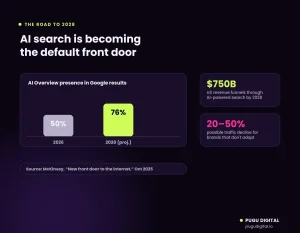
- AI-generated summaries appear in half of Google’s results and could reach 75% by 2028, potentially cutting traditional search traffic by 20-50% for businesses that don’t adapt
- Structured data has become essential, with 72% of first-page results using schema markup to help AI systems understand and display content
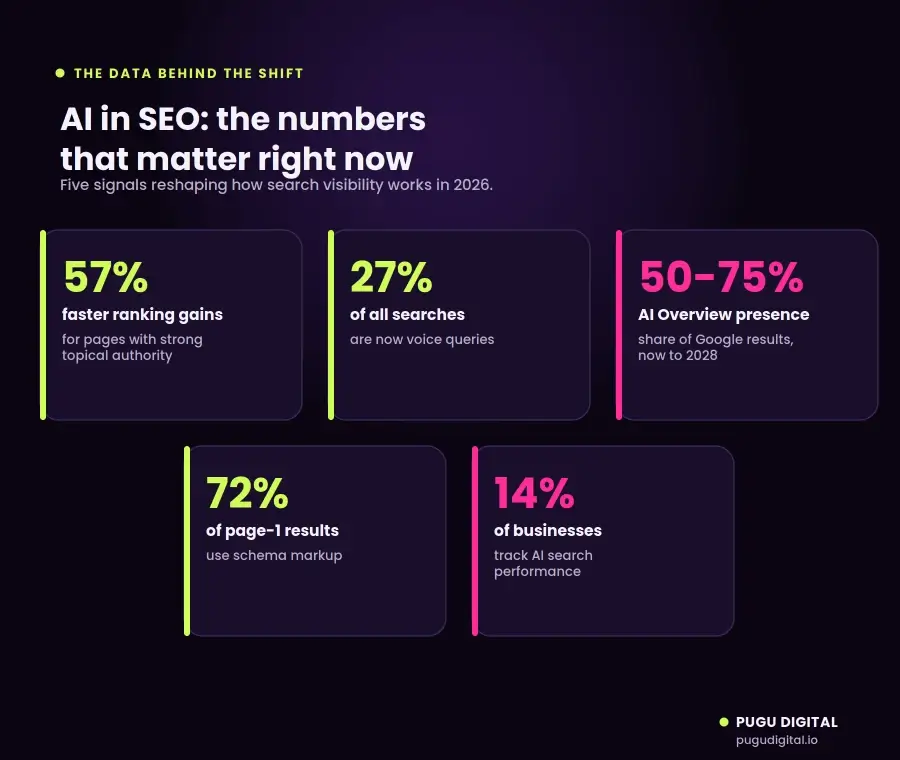
Search engines like ChatGPT and Google’s AI Overview are changing how people find information. You need to optimize for both traditional rankings and AI-generated responses. Only 14% of businesses currently track their performance in AI search results, and 80% struggle with AI visibility, which means early movers have a significant advantage in using AI in SEO.
How AI Changed Search Engine Optimization
Machine learning algorithms now power every query processed by major search platforms. Google uses these algorithms to constantly measure user behavior and surface the most relevant content. This represents a fundamental shift from earlier systems that relied on simple keyword matching without considering context or user intent.
RankBrain and BERT
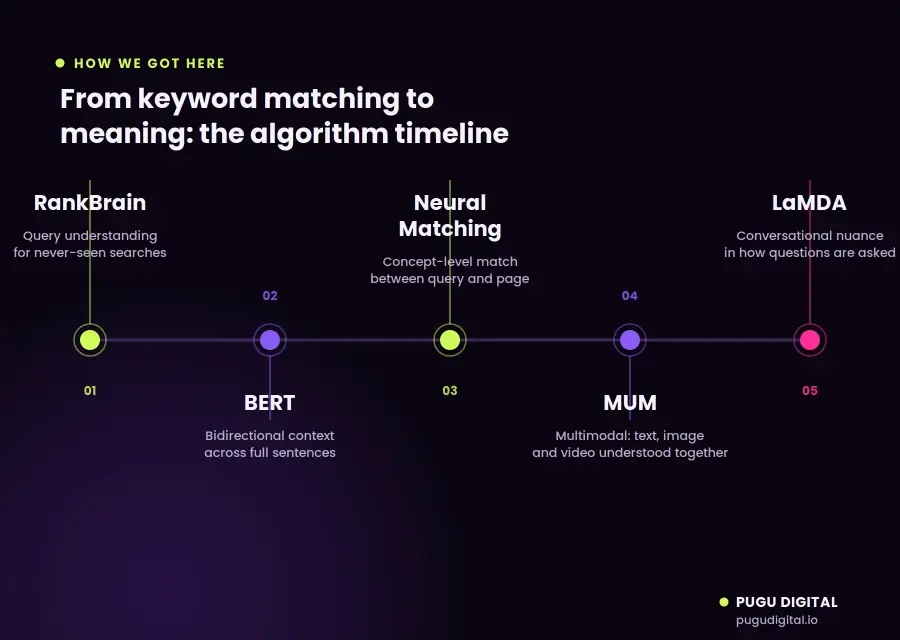
The evolution started with RankBrain, introduced to handle queries Google had never seen before. Search engines gained the ability to comprehend meaning rather than just match words by viewing search queries as things and entities instead of strings of characters. BERT brought bidirectional understanding to the table shortly after. This wasn’t a minor update.
Take the case of a phrase like “the car is red,” where previously the word red came after car, and that positional information wasn’t sent backward through the algorithm. BERT changed this by analyzing the entire sequence of words to understand how combinations express different meanings and intent.
Neural Matching, MUM, and LaMDA
Neural matching followed, helping search platforms understand how queries relate to pages by examining content within its full context. Most queries processed now make use of neural matching in their ranking calculations.
MUM advanced this further by introducing multimodal capabilities, allowing search systems to understand different content formats like text, images, and video simultaneously. LaMDA brought conversational understanding to search, using pattern recognition in sentences and word correlations to grasp nuanced questions.
Natural language processing (NLP) stands as one of the primary machine learning realms utilized in search engine optimization. Search platforms use AI to analyze meta tags, URLs, and search queries through neural networks to determine user intent with precision. This data-driven approach has made general-purpose solutions insufficient for driving maximum search engine results improvements, hence you need AI for your SEO.
AI in SEO Tools: What’s Actually Working for Keyword Research and Content
AI SEO tools have moved past simple automation. These platforms now use machine learning to spot patterns across massive datasets, turning raw search data into strategies that actually work.
AI Keyword Research Tools for Semantic Search
Semantic keywords are words or phrases that relate to your target topic, not just exact match terms you want to rank for. “Italy” and “dough” connect semantically to “pizza,” though you wouldn’t necessarily target these standalone terms. Search engines use semantic search instead of simple keyword matching, trying to match the meaning of queries with the meaning of pages.
AI powered SEO tools like openSEO, Juma, LowFruits, and Semrush excel at analyzing large quantities of keyword data to extract patterns and generate insights. Machine learning enables these platforms to cluster keywords at scale, provide personalized keyword difficulty scores based on domain strength, and conduct content gap analysis.
Moreover, Perplexity works well for AI in SEO to generate keyword ideas and enrich existing content. ChatGPT offers keyword brainstorming, intent analysis, and clustering help, though it lacks actual search volume data.
AI Content Optimization and Writing Tools
Writesonic operates as an all-in-one platform that combines research, writing, optimization, and publishing. Its Chatsonic feature allows queries across multiple LLMs, including OpenAI’s recent models, Anthropic’s Claude, and Google’s Gemini, with real-time data from connected SEO tools.
Clearscope analyzes top-ranking pages to provide keyword suggestions, readability metrics, and content structure recommendations. SurferSEO examines high-ranking content to deliver data-driven plans covering word count, keyword frequency, and questions to answer. MarketMuse identifies content gaps that represent topics competitors cover, but you don’t.
Build Your Own AI Writer Instead of Renting One
There is another route that often gets overlooked, and it is the one we went with at Pugu Digital. Rather than paying a monthly subscription, you can build your own AI writer tuned to how you work. Ours currently runs on Opus 4.8, writes from pre-made templates, and plugs into our SEO suite through OpenSEO. It researches each topic automatically, lists sources in order, drafts the article, suggests links to add and chase, and runs a plagiarism check. The upfront effort is real, but you own the system instead of renting one.
Technical SEO Tools That Actually Save Time
Technical SEO platforms automate processes that eat up excessive time when done manually. Seobility’s Website Audit scans sites for technical problems and on-page issues that impact search visibility and AI system comprehension.
SE Ranking can crawl up to 1,000 pages in under two minutes, analyzing HTML tags, Core Web Vitals, and generating prioritized issue lists. Ahrefs provides Internal Link Opportunities recommendations based on anchor text and target URLs across entire websites.
Maybe it’s time to add some of these AI-powered tools to your SEO workflow if you haven’t already.
Building Topical Authority With AI-Driven Content Strategy
Topical authority has become one of the most effective ranking strategies available to SEO practitioners today. Leaked internal Google documents from 2024 confirmed what many suspected: Google uses site-level authority signals, especially for sensitive topics. The numbers speak for themselves – pages with high topical authority gain traffic 57% faster than those with low authority.
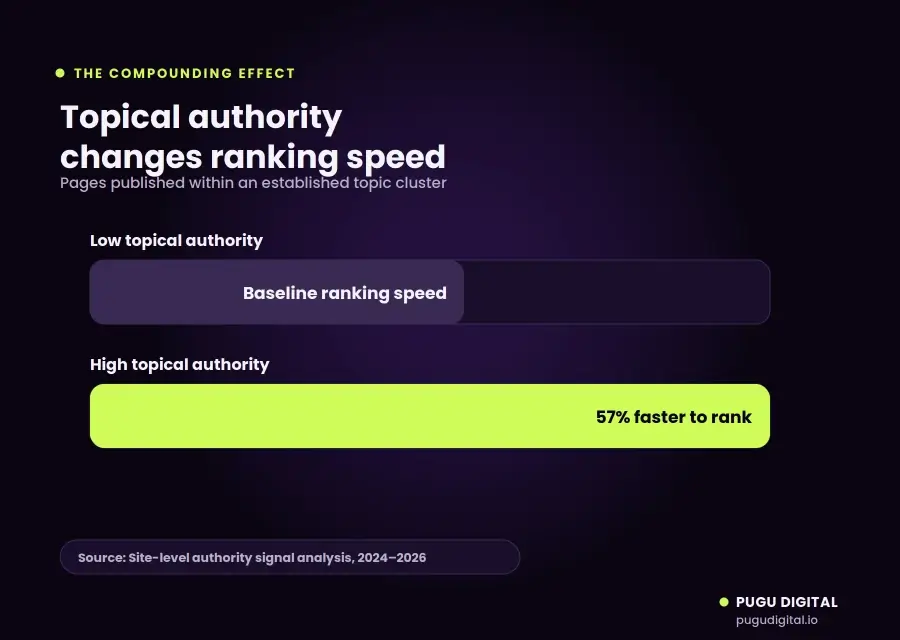
Sites that systematically build expertise see faster ranking improvements for new content, better performance across related keywords, and stronger resilience during algorithm updates. This isn’t just about creating more content – it’s about creating the right content that demonstrates deep knowledge across related topics.
AI-driven content clustering tools make this process significantly faster. Instead of creating isolated articles, these platforms identify subtopics, organize search intent, surface internal linking opportunities, and streamline content planning. The Originality.ai Predictive SEO Tool shows how your content stacks up against competitors, identifies relevant keywords for building topical authority, and provides suggestions for ranking more competitively.
Here’s what systematic topical authority building looks like:
- Content clustering around core topics – Rather than random article creation.
- Internal linking strategies – Connecting related content to show expertise depth.
- Gap analysis – Finding topics competitors cover that you don’t.
- Search intent mapping – Addressing different user needs within your topic area.
Predictive Analytics for SEO Performance Tracking
Privacy changes and first-party data requirements are reshaping how we measure SEO success. The shift moves toward modeled attribution and consented datasets. Machine learning now forecasts website traffic based on keyword ranking changes, spots performance anomalies before they impact results, and identifies opportunities even when user behavior becomes harder to track.
The results can be substantial. Predictive analytics can meaningfully improve organic traffic and revenue outcomes over time, though gains vary widely by starting point and implementation. Google Analytics 4 offers AI-driven insights that fill gaps left by reduced cookie tracking.
What does this mean for your AI in SEO strategy? You need tools that can predict performance trends rather than just report what already happened. Agencies like Pugu Digital combine multiple predictive analytics platforms to create SEO strategies that deliver measurable results through this blend of technology and expertise.
Technical AI in SEO Implementation: On-Page SEO and Link Building
Putting AI in SEO to work for on-page optimization and link building means going beyond tool selection. Search engines now expect content that both algorithms and AI systems can understand without ambiguity.
Schema Markup and AI Content Structure
Schema markup turns web pages into machine-readable data that AI systems can process accurately. Over 72% of first-page results use schema markup. JSON-LD remains the recommended implementation format.
Structured data drives rich results that consistently improve click-through rates. Organizations report up to 80% increase in engagement on pages displaying rich results. The markup helps search engines understand exactly what your content covers, whether that’s a local business, product reviews, or FAQ sections.
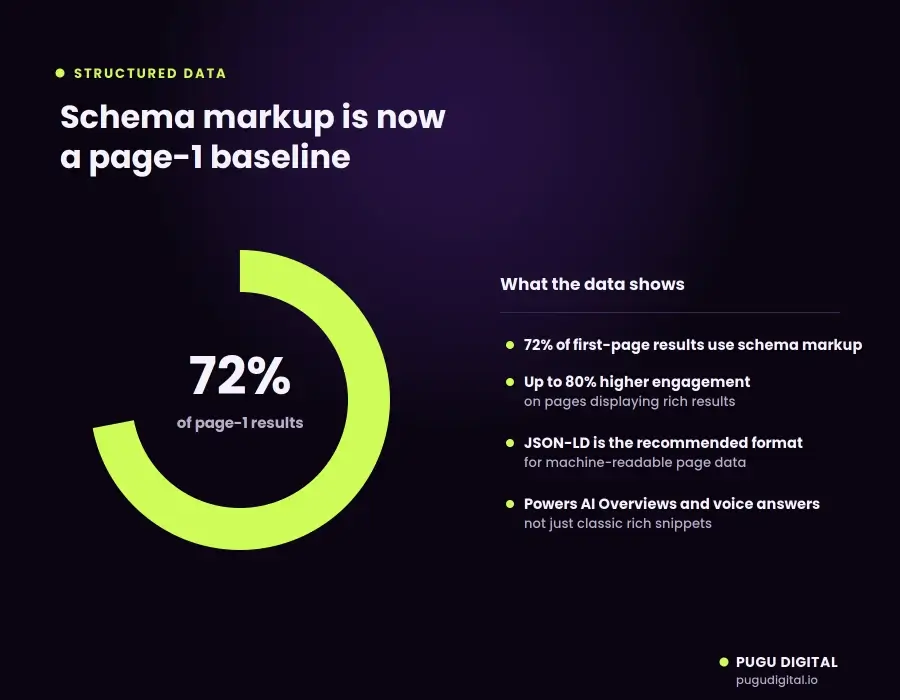
This isn’t just about appearing in rich snippets anymore. AI-powered search features rely on structured data to extract and present information in answer boxes, voice responses, and AI overviews.
Link Quality Assessment Through AI
AI backlink analysis tools use machine learning to evaluate link quality in real time. These systems examine contextual relevance and anchor text patterns while identifying valuable linking opportunities.
Tools like Ahrefs maintain databases with over 43 trillion backlinks, updating hourly to provide current competitive intelligence. What makes AI analysis different is the speed and pattern recognition. Instead of manually reviewing hundreds of potential link sources, AI systems can evaluate domain authority, topical relevance, and link placement context simultaneously.
Voice Search and Natural Language Queries
Voice queries account for roughly 27% of all searches, with 40.7% of voice results coming from featured snippets. These searches tend to run longer and more conversational than typed queries, following natural speech patterns. About 76% include location-specific intent.
Optimizing for voice means structuring content to answer questions directly. Use clear headings that match how people actually ask questions. Consider the difference between typing “best GEO Sofia” versus asking “What’s the best GEO agency in Sofia?”
Generative Engine Optimization
GEO focuses on structuring content for AI-powered answer engines rather than traditional rankings. When AI Overviews appear in search results, traditional result pages see a 58% (according to Ahrefs latest study) drop in click-through rates.
Citation frequency and extractable content structure determine which sources appear in generative responses. This means organizing information in clear, quotable sections that AI systems can easily extract and attribute.
E-E-A-T and Content Quality Standards
Experience, expertise, authoritativeness, and trustworthiness form Google’s quality framework, with trust as the most critical element. Google’s systems prioritize content that demonstrates first-hand experience and verifiable expertise, especially for YMYL topics affecting health, finance, or safety.
Maybe it’s time to focus more on demonstrating real expertise rather than just targeting keywords. AI systems are getting better at identifying authentic experience versus generic content optimization.
What’s Coming Next for AI in SEO and Search
Search behavior has shifted toward AI-powered platforms. Therefore, using AI in SEO is no longer debatable. Consumers now turn to ChatGPT, Gemini, Copilot, Claude, Perplexity, and Google’s AI Overview to guide purchasing decisions and discover brands. Traditional search channels face significant changes that require immediate strategic adaptation.
Half of consumers intentionally seek out AI-powered search engines, with the majority saying it’s their top digital source for buying decisions. AI summaries already appear in about 50% of Google searches, a figure expected to rise to more than 75% by 2028. By 2028, $750 billion (McKensey latest report) US revenue will funnel through AI-powered search. Unprepared brands may experience traffic declines anywhere from 20 to 50% from traditional search channels.
Natural Language Queries Replacing Keyword-based Approaches
Multimodal search combining text, visual, and voice inputs requires optimization across multiple formats. Personalization through AI remembers previous conversations and tailors answers based on search history. Ad-free models like SearchGPT may reduce paid placement availability, forcing brands to prioritize organic visibility.
Just 16% of brands systematically track AI search performance. This creates opportunities for businesses that adapt early. Companies need to optimize content for both traditional rankings and AI-driven queries, ensuring visibility across evolving touchpoints where consumers make decisions.
What Does This Mean for SEO Practitioners?
The focus shifts from ranking for specific keywords to adding AI in SEO, creating content that artificial intelligence systems can understand, extract, and cite. Structured data becomes more important than ever. Content needs to answer questions directly and provide clear, factual information that generative engines can confidently reference.
Final Words
AI-powered search optimization demands immediate adaptation. We’ve explored how machine learning algorithms, semantic keyword research tools, content clustering platforms, and GEO strategies are reshaping rankings in 2026. Traditional approaches no longer suffice. Given that AI summaries now dominate search results, brands must optimize for both conventional rankings and generative engines.
Reach out to any of our experts here at Pugu Digital and discuss your AI SEO strategies that position your business for long-term visibility and growth.
AI in SEO Reshaping Search Rankings FAQs
What is AI in SEO and why is it important in 2026?
AI in SEO refers to the use of artificial intelligence and machine learning technologies to optimize websites for search engines. It has become essential because search platforms now rely heavily on AI algorithms like RankBERT, BERT, and neural matching to interpret user queries and rank content. Traditional keyword-focused methods are no longer sufficient, as modern search demands topical authority, structured content, and deep understanding of user intent.
How do AI tools improve keyword research compared to traditional methods?
AI keyword research tools use machine learning to analyze massive datasets and identify semantic relationships between terms rather than just exact matches. They can cluster keywords at scale, provide personalized difficulty scores based on your domain strength, conduct content gap analysis, and understand how words relate conceptually to your target topic. This semantic approach aligns with how modern search engines interpret queries.
What is topical authority AI in SEO and how does it help build it?
Topical authority refers to a website’s recognized expertise on a specific subject area. AI-driven content clustering tools help build this by identifying subtopics, organizing search intent, surfacing internal linking opportunities, and accelerating content planning. Pages with high topical authority gain traffic faster and see better performance across related keywords, with AI tools helping to systematically develop this expertise.
How is voice search changing SEO strategies?
Voice queries now represent approximately 27% of all searches, with 40.7% of voice results pulling from featured snippets. Voice searches are conversational, averaging four to seven words, and mirror natural speech patterns. About 76% carry location-specific intent, requiring optimization for natural language queries and structured data that AI assistants can easily extract and present as answers.
What is GEO optimization and why does it matter?
Generative Engine Optimization (GEO) structures content specifically for AI-powered answer engines rather than traditional search rankings. With AI summaries appearing in about 50% of Google searches and expected to reach over 75% by 2028, optimizing for citation frequency and extractable content structure determines visibility in these AI-generated responses. Brands that don’t adapt may experience traffic declines of 20-50% from traditional search channels.