
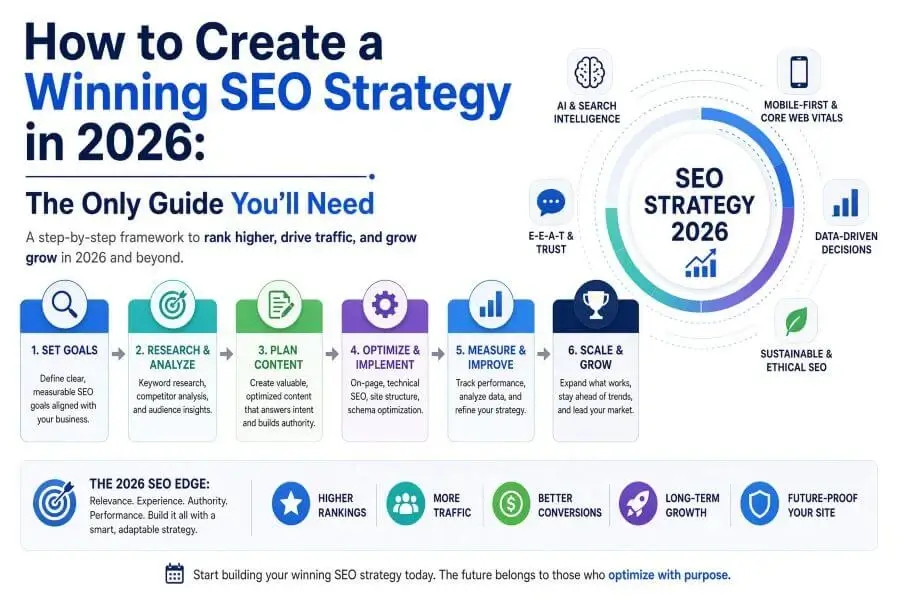
In this guide, I walk you through how to build an SEO strategy in 2026 that holds up. Something has changed about how search works, and it affects every business with an online presence.
Search has moved from a click game to an authority game. AI models scan content for real human experience and reward authority across interconnected channels. The old playbook — chase rankings to drive traffic — still has a place, but it’s no longer the whole picture. Today, getting cited in an AI-generated answer can be just as valuable as holding a top-three ranking position.
SEO Strategy in 2026 Key Takeaways
SEO in 2026 looks very different from what it did even two years ago. Here’s what matters most:
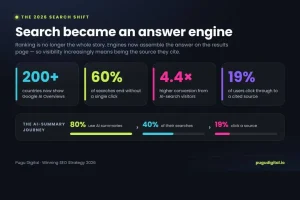
- The search landscape has shifted. Search engines don’t just rank pages; they synthesize answers from multiple sources and present them directly in results. AI Overviews now appear in over 200 countries, and roughly 60% of searches yield no clicks as users get answers without ever visiting a website.
- E-E-A-T is your competitive advantage. Google’s 2026 updates prioritize in-depth, original content that demonstrates real human experience over generic AI-generated information. Firsthand insights and verifiable expertise are what separate strong content from forgettable content.
- Structure content for AI citation, not just rankings. Self-contained 75-150 word blocks answering specific questions, question-based headings, definitive language, and structured data all increase citation probability across AI platforms.
- Technical optimization is non-negotiable. Core Web Vitals directly impact rankings and conversions. Sites loading in one second maintain 40% conversion rates versus 34% for two-second sites. Schema markup, mobile optimization, and crawlability issues all deserve attention.
- Track AI visibility alongside traditional metrics. Monitor brand mentions in ChatGPT, Perplexity, and Google AI Overviews. AI search visitors convert 4.4 times better than traditional organic visitors — quality citations matter more than raw traffic volume.
The approach we use here at Pugu Digital combines topic clustering, intent-focused content, technical optimization, and cross-platform optimization to build authority that AI systems actually recognize and cite.
Understanding the 2026 SEO Landscape
Search engines no longer simply retrieve and rank pages. They synthesize answers from multiple sources, evaluate competing claims, and present information directly within results pages. So, ranking position matters less today when users consume AI-assembled summaries instead of clicking through to websites. I’m sure we have all seen this firsthand.
AI Overviews Are Becoming the Destination, Not the Doorway
AI Overviews now appear in over 200 countries, delivering synthesized answers without requiring site visits. The results page has effectively become an answer destination rather than a navigation tool.
Earning a citation within AI-generated responses is now as valuable as securing a top-three ranking position.
Discovery Has Fragmented Beyond Google
The fragmentation extends beyond Google too. Discovery happens across social platforms, forums, video search, conversational assistants, and specialized AI engines. Users search Reddit for peer experiences, YouTube for visual demonstrations, and LLMs such as ChatGPT for synthesized explanations.
Content needs presence across these surfaces, not just optimization for a single search engine. Brands that optimize solely for Google risk missing significant discovery opportunities happening elsewhere.
Traditional SEO Fundamentals Still Matter — The Context Has Changed
Traditional SEO fundamentals haven’t vanished, though. Keyword research, technical optimization, quality content, and authority building remain essential. What changed is the context surrounding these practices.
- Keywords now inform topic ecosystems rather than individual page targets.
- Technical optimization makes your content easy to parse for both traditional search crawlers and AI agents.
- Quality signals help AI systems determine which sources deserve citation within generated answers.
Fewer Clicks, Higher Intent
There’s an interesting counterbalance worth noting here, and it ties directly into GEO. AI search visitors are worth 4.4 times more than traditional organic search visitors from a conversion perspective. Fewer clicks arrive, but those who do visit show stronger intent and engagement.
Roughly 80% of consumers use AI summaries for at least 40% of their searches, yet only about 19% click through to cited sources.
E-E-A-T Is Now the Primary Differentiator
E-E-A-T (Experience, Expertise, Authoritativeness, Trustworthiness) has become the primary differentiator. Google rewards content demonstrating real human experience over generic information easily synthesized by AI.
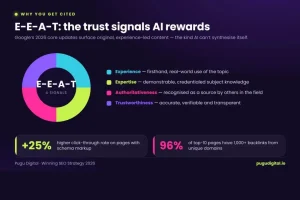
The February 2026 Discover core update specifically prioritized in-depth, original content from websites with topic-specific expertise. The May 2026 broad core update continued this pattern, designed to better surface relevant, satisfying content from all types of sites.
Technical Signals Still Carry Weight
Core Web Vitals directly influence rankings, with sites achieving excellent scores seeing measurable conversion rate improvements. Mobile-first indexing is non-negotiable at this point.
Voice search adoption continues climbing, which means content needs to be optimized for conversational queries and natural language patterns.
The Agentic Web Is Next
The agentic web represents what’s coming next. AI assistants will move beyond recommending products to executing transactions on behalf of users.
Search optimization must now account for machine readability, API compatibility, and structured data that allows AI agents to parse inventory and pricing in real-time.
The Trust Gap AI Overviews Still Have to Close
Over 40% of users report seeing inaccurate or misleading content in AI Overviews, and that trust gap is significant. Authoritative, verifiable content becomes more valuable precisely because of this.
Search systems increasingly evaluate meaning, relationships, and credibility signals rather than keyword frequency alone. Your SEO strategy must address both traditional search and AI citation simultaneously, recognizing these as related but distinct optimization challenges.
Conduct Your SEO Foundation Audit
A solid SEO strategy starts with an honest assessment of where things currently stand. Before optimizing for AI citations or mapping out a content plan, you need baseline data that reveals what drives your current organic traffic, where competitors outperform you, and which metrics actually connect to real business outcomes.
Analyze Current Performance and Traffic
Start with Google Search Console. Examine clicks, impressions, and traffic patterns, then cross-reference that data with GA4 to understand how visitors actually behave after arriving from search. Organic traffic from unpaid search results remains the primary indicator of SEO health.
A few metrics worth tracking closely:
- Sessions and unique visits — unique visits strip out repeat visitors and give you cleaner acquisition data
- Bounce rate — industry averages hover around 40%, so anything significantly higher warrants a closer look
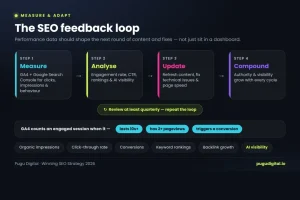
- Engagement rate — GA4 measures this as sessions lasting 10 seconds or longer, containing at least two pageviews, or triggering a conversion event
- Core Web Vitals — run your site through Google PageSpeed Insights to evaluate Largest Contentful Paint, Interaction to Next Paint, and Cumulative Layout Shift scores
Engagement rate is particularly useful here. It directly reflects whether your content satisfies search intent, which makes it a much more meaningful signal than traditional bounce rate alone.
Identify Competitor Strategies
SEO performance doesn’t exist in a vacuum. Your organic competitors may not be the same as your business rivals. They’re simply the sites ranking for keywords you’re targeting. Tools like Semrush’s Domain Overview help identify these competitors based on keyword overlap.
Keyword gap analysis shows terms competitors rank for that you don’t. Filter by search intent and keyword difficulty to find the highest-value opportunities. Then examine how those competitors structure their top-ranking pages, their topic coverage, use of comparison tables, and whether they address multiple related search intents on a single page.
Backlink profiles reveal authority gaps too. Look beyond total referring domain counts and assess where competitors actually earn their links. Editorial links from industry publications and original research carry more weight than directory listings.
One area that’s easy to overlook: check competitors’ AI visibility. Track which prompts in ChatGPT, Perplexity, Claude, or Google AI Overviews cite them rather than you. Their presence on Reddit threads, YouTube, and niche forums also builds trust signals that search engines pick up on.
Define SMART SEO Goals and KPIs
Vague targets like “increase organic traffic” don’t hold up during execution. SMART goals provide the structure needed to track real progress:
- Specific — define the exact outcome you’re after
- Measurable — identify how and where you’ll track it
- Achievable — align targets with your resources and competitive landscape
- Relevant — connect goals directly to business objectives
- Time-bound — set a deadline and establish pacing expectations
Base your targets on historical data and competitor benchmarks. If organic traffic grew 5% last year, targeting 8–10% growth over the next six months is a realistic stretch.
Track KPIs including organic impressions, click-through rate, conversion rate, average page load time, keyword rankings, and backlink acquisition.
Map Your Target Audience and Search Intent
Search intent determines content format and structure. Get this wrong and even well-written content won’t rank. There are four intent types worth understanding:
- Informational — users seeking knowledge or answers
- Commercial investigation — users comparing options before a decision
- Transactional — users ready to purchase or act
- Navigational — users looking for a specific site or page
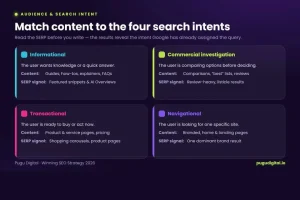
Study the actual search results for your target keywords before writing anything. When guides dominate the first page, intent is informational. Product pages signal transactional intent. Review-heavy SERPs suggest commercial investigation.
Free tools like Yoast SEO with Semrush integration provide intent labels alongside related keywords, which helps match your content format to what users actually expect to find.
Implement Technical and On-Page Optimization
A strong content strategy only gets you so far. Without solid technical execution, even the best content can go unnoticed by both search crawlers and AI agents.
Fix Core Web Vitals and Site Speed
Page speed directly correlates with rankings and conversions. Websites loading in one second maintain conversion rates around 40%, while two-second load times pull that figure down to 34%. That difference matters for the bottom line.
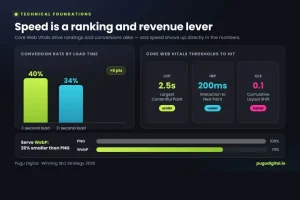
Optimize images using WebP format, which produces files 26% smaller than PNG equivalents. Enable Gzip compression, implement browser caching, and minify JavaScript and CSS files.
The Core Web Vitals benchmarks to hit:
- Largest Contentful Paint: under 2.5 seconds
- Interaction to Next Paint: under 200 milliseconds
- Cumulative Layout Shift: below 0.1
Google PageSpeed Insights will give you a clear picture of where your site currently stands on each of these.
Optimize Internal Linking Structure
Search engines discover new pages by following links from known pages. Internal links do two things well: they distribute authority across your site and signal to crawlers which pages matter most.
Use descriptive anchor text rather than generic phrases like “click here.” Build hub-and-spoke structures where pillar pages link out to related cluster content and cluster pages link back.
Pages with dozens of internal links receive substantially more clicks than those with few connections. That’s a straightforward win most sites leave on the table.
Add Schema Markup and Structured Data
Schema markup gives search engines explicit context about your content rather than requiring them to infer it. A client of ours measured a 25% higher click-through rate on pages with structured data. That kind of lift is hard to ignore.
Use JSON-LD format for Product, Article, Local Business, and FAQ schemas. AI systems increasingly rely on structured data to understand and cite content, which makes schema implementation doubly important in the current search environment.
Ensure Mobile Optimization and Crawlability
Mobile-first indexing makes responsive design mandatory, not optional. Beyond that, check that your robots.txt file allows access to CSS and JavaScript, use logical URL structures, and submit XML sitemaps.
It’s also worth auditing for noindex tags applied to pages that should be indexed, broken navigation links, and JavaScript rendering issues that prevent crawlers from accessing your content. These are common problems that can quietly suppress visibility.
Build High-Quality Backlinks
Over 96% of top-ten ranking sites have more than 1,000 backlinks from unique domains. Links from authoritative, relevant domains remain one of the strongest trust signals available.
The approach that works: earn editorial links through original research, digital PR, and guest contributions. Purchasing links creates short-term gains, but can cause long-term risk. Focus on the kind of links that come naturally when your content is genuinely worth citing.
Optimize Title Tags and Meta Descriptions
Title tags function as both ranking factors and CTR drivers. Keep titles between 51 and 60 characters, place primary keywords near the beginning, and make sure every page has a unique title. Duplicate titles are a surprisingly common oversight.
Meta descriptions should stay under 140 characters and include a clear explanation. Worth noting: Google only uses the provided meta description roughly 28% of the time, so while it’s not always within your control, writing a strong one still increases the odds it gets used.
Track Performance and Adapt Your SEO Strategy
Data tells you what’s working. Without consistent measurement, SEO becomes guesswork, and guesswork is an expensive way to run a strategy.
Monitor Key Metrics with Google Analytics
GA4 uses an event-based tracking model where every user interaction registers as an event. The engagement rate metric measures sessions lasting longer than 10 seconds, sessions with two or more pageviews, or sessions that trigger a conversion event. This gives a clearer picture of meaningful interactions than the old bounce rate ever could.
Track traffic acquisition to understand which channels are actually delivering visitors. Examine average engagement time to measure how long users actively interact with your content. Connect GA4 with Google Search Console to link keyword performance data with on-site behavior. A page ranking well but showing a sharp engagement drop-off is a content problem, not a link building problem.
Use Google Search Console for Insights
Google Search Console shows the exact queries users search when finding your site. Click-through rate data reveals whether your meta titles and descriptions are compelling enough to earn the click. Low CTR despite strong rankings is usually a sign that your messaging doesn’t match what users actually want.
The Performance report tracks clicks, impressions, and average position over time. Filter by specific query terms to discover which searches drive traffic to your pages. The Pages section identifies your top-performing URLs and the queries associated with them.
Measure AI Visibility and Brand Mentions
AI visibility tracking is now a real part of the measurement picture. It monitors how often your brand appears in responses generated by large language models. Track citation share of voice, whether source URLs are included, and the sentiment around mentions. Tools that cover ChatGPT, Perplexity, Gemini, and Google AI Overviews are worth adding to your reporting stack.
Set up brand monitoring workflows that track your brand name, common misspellings, product names, and key personnel. Configure alerts for high-impact mentions from publications with significant audiences. Monitor branded search volume trends using Google Search Console or similar platforms to spot changes in brand awareness.
Update Strategy Based on Results
Review performance at least quarterly. Regular analysis keeps SEO efforts aligned with business goals and surfaces problems before they compound. User engagement data is particularly useful here as it reveals whether content is genuinely matching search intent.
Review search data, user journeys, and site performance together to identify which topics drive both traffic and conversions. When you find content that performs well, create more in the same format.
For underperforming pages, analyze scroll depth and time on page to understand where users lose interest. Update pages that are losing traffic, act on early engagement signals, and address site speed when average engagement time starts to decline.
The goal is a feedback loop, not a one-time audit. What you learn from performance data should directly shape the next round of content, technical fixes, and optimization priorities.
The Winning SEO Strategy in 2026 – Conclusion
I have now covered how to create a simple yet winning SEO strategy for 2026. This guide provides a complete roadmap for building a strategy that performs across traditional search and AI-powered discovery platforms. The fundamentals remain essential, but your execution must adapt to where users actually search and consume information.
Success requires consistency in tracking, testing what resonates with your audience, and refining your approach based on real performance data. As long as you prioritize helpful content and technical excellence, your visibility will compound over time.
Take the next step in your SEO journey by contacting Pugu Digital today for a free consultation call and receive a personalized SEO strategy tailored to your business goals.
SEO Strategy in 2026 FAQs
How has SEO changed in 2026 compared to previous years?
A performance based SEO strategy in 2026 has shifted from focusing solely on keyword rankings to optimizing for AI citations and user intent. Search engines now prioritize content demonstrating real human experience, expertise, and trustworthiness (E-E-A-T).
AI Overviews and generative search experiences mean that visibility now includes being cited in AI-generated summaries, not just ranking high in traditional search results. Technical fundamentals like Core Web Vitals and mobile optimization have become mandatory rather than optional.
Does AI-generated content still work for SEO in 2026?
AI-generated content can work as a starting point, but it requires significant human editing and enhancement to rank well. Search engines can distinguish between generic AI content and content enriched with original insights, firsthand experience, and specific examples.
The most successful approach is using AI for research and drafts, then adding authentic expertise, case studies, and unique perspectives that AI cannot replicate.
What is topical authority and why does it matter for SEO?
Topical authority means being recognized as a comprehensive, expert source on a specific subject rather than just ranking for individual keywords. It involves creating interconnected content clusters where pillar pages cover broad topics and supporting pages address specific subtopics, all linked together.
This SEO strategy approach signals to both search engines and AI systems that your site offers deep, reliable coverage of a topic, leading to more stable and sustainable rankings.
How can I optimize my content to be cited by AI search tools?
To increase AI citation chances, structure your content in self-contained blocks of 75-150 words that answer specific questions independently. Use question-based headings, present information in tables or numbered lists, and employ definitive language with specific facts and numbers.
Add schema markup and structured data, ensure content is recently updated, and make each section readable without requiring context from other parts of the page.
What metrics should I track to measure SEO strategy success in 2026?
Beyond traditional metrics like organic traffic and keyword rankings, track engagement rate (sessions lasting over 10 seconds with meaningful interaction), Core Web Vitals scores, click-through rates from search results, and conversion rates.
Additionally, monitor AI visibility by tracking how often your brand appears in AI-generated responses across platforms like ChatGPT, Perplexity, Claude, and Google AI Overviews. Brand mentions across forums, social platforms, and industry publications also serve as important trust signals.