
Key Takeaways:
The story of Google’s Quality Rater in 2026 is not a single dramatic rewrite of the guidelines. It is a steady tightening of what “trustworthy” means, confirmed by a highly volatile core update in March.
- Quality Rater Guidelines never rank your site directly. Human raters use them to score sample results, and that feedback trains the classifiers that shape both search results and AI answers.
- The last confirmed guidelines update landed on September 11, 2025. It refreshed the YMYL definitions and added examples for AI Overviews. Google described it as minor, with no change to its rating guidance.
- The real disruption came from the March 2026 core update, one of the most volatile in years. Roughly 79.5% of top-three results changed position, up from 66.8% in December.
- That update rewarded first-party, official and authoritative sources. It demoted aggregators, user-generated platforms and pages built mainly to capture search traffic.
- AI-assisted content is still allowed. Thin, mass-produced content with no genuine human value is not, and it falls under Google’s scaled content abuse policy regardless of whether a person or a machine wrote it.
The pattern is simple. Original, first-party content from a named, credible source is gaining ground. Repackaged summaries and anonymous, search-first pages are losing it.
What the Quality Rater Guidelines Actually Are
Google’s Search Quality Rater Guidelines are the instructions given to thousands of human evaluators who rate the quality of sample search results. Those ratings do not move any single page up or down. Instead, they act as a report card that Google uses to test and train the systems that do rank pages, including the systems behind AI Overviews and AI Mode.
This distinction matters because it explains why “following the guidelines” is not a ranking hack. It is a description of the quality bar Google is training its algorithms to reward over time. When the guidelines change, they signal where that bar is heading. When a core update lands, that is when rankings actually shift.
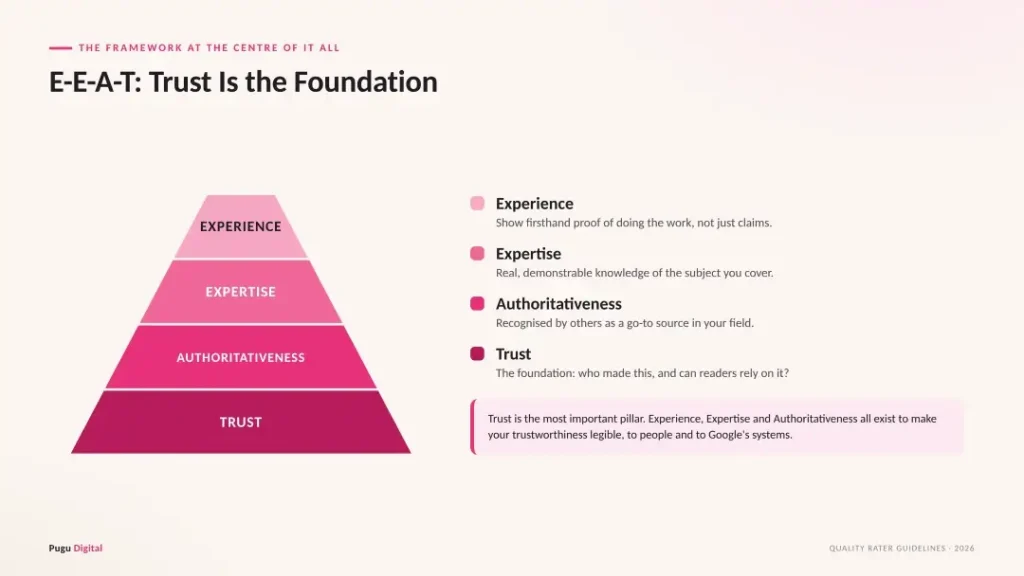
The framework at the center of it all is E-E-A-T: Experience, Expertise, Authoritativeness and Trustworthiness. Google added the second E, for Experience, back in December 2022, and it has been sharpening what counts as real experience ever since.
The Real 2025 to 2026 Timeline
It helps to separate what genuinely happened from the noise, because a lot of secondhand commentary in 2026 has blurred the two.
January 2025: AI Content and Scaled Abuse Get Defined
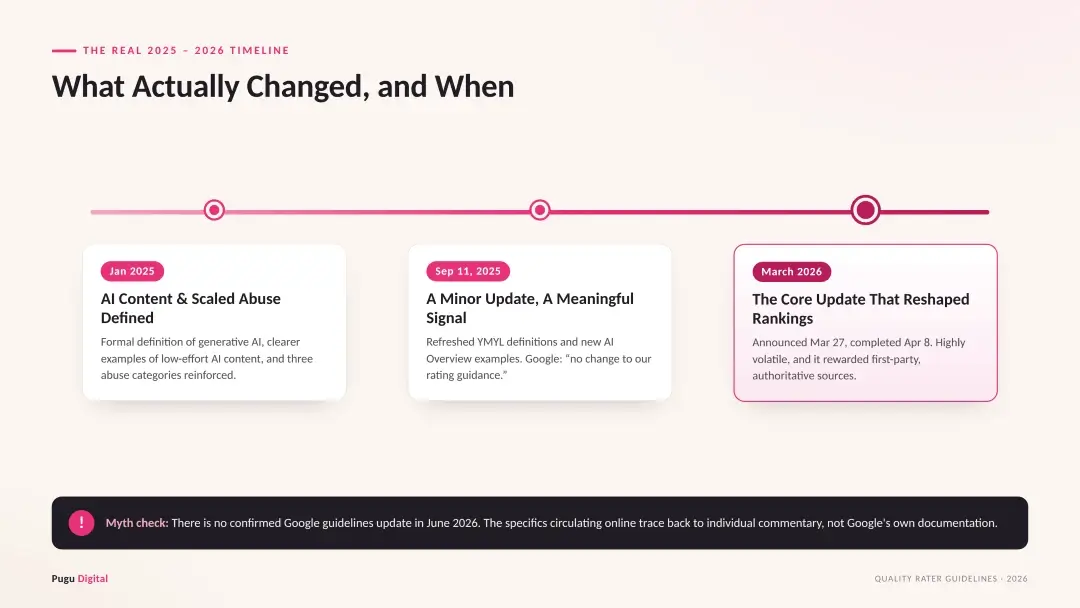
The January 2025 guidelines update did real work. It added a formal definition of generative AI, introduced clearer examples for spotting low-effort AI content (including telltale placeholder phrases), and reinforced three abuse categories that still matter today: expired domain abuse, site reputation abuse, and scaled content abuse. Raters were even instructed to disable ad blockers so they could judge the real page experience, ads included.
September 11, 2025: A Minor Update With a Meaningful Signal
The most recent confirmed guidelines update arrived on September 11, 2025. Google refreshed its YMYL definitions and added examples covering newer features like AI Overviews. In Google’s own words, this was “a minor update” with “small clarifications and a handful of new examples,” and it made “no change to our rating guidance.”
That last line is worth holding onto. The rating philosophy did not change. What changed was clarity, especially around sensitive YMYL topics where inaccurate information can cause real harm. If you have seen claims of a dramatic “June 2026 overhaul” with brand-new named sections and flags, treat them with caution. There is no confirmed Google guidelines release in June 2026, and the specifics circulating online trace back to individual commentary rather than Google’s own documentation.
March 2026: The Core Update That Reshaped Rankings
This was the defining search event of 2026. Google announced the March 2026 core update on March 27 and confirmed it complete on April 8. The volatility was severe. About 79.5% of top-three URLs changed position (up from 66.8% in December), 90.7% of top-ten results shifted, and roughly 24.1% of pages that had rankedstatic.googleusercontent.com/media/guidelines.raterhub.com/ in the top ten dropped out of the top 100 entirely.
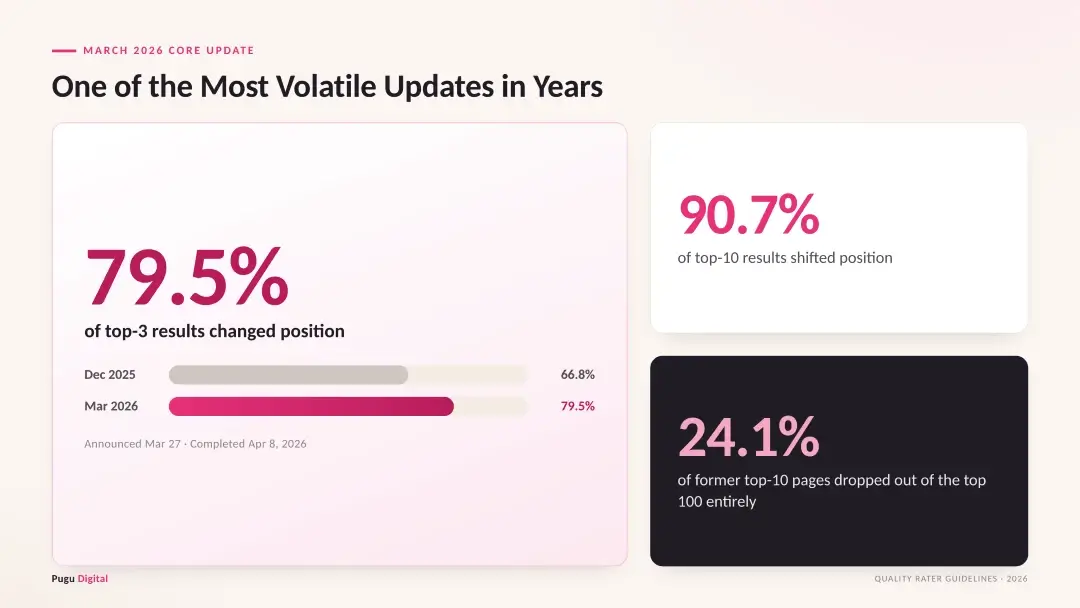
More important than the numbers is the direction. This was, in effect, a first-party and official-source correction.
Who Won and Who Lost in March 2026
The winners shared one trait: they owned their subject at the source. Streaming and software companies ranking for their own products, hotels and airlines selling directly, and authoritative institutions such as government and academic domains all gained ground. When a page is the primary source of the information it presents, the March update treats it as more trustworthy.
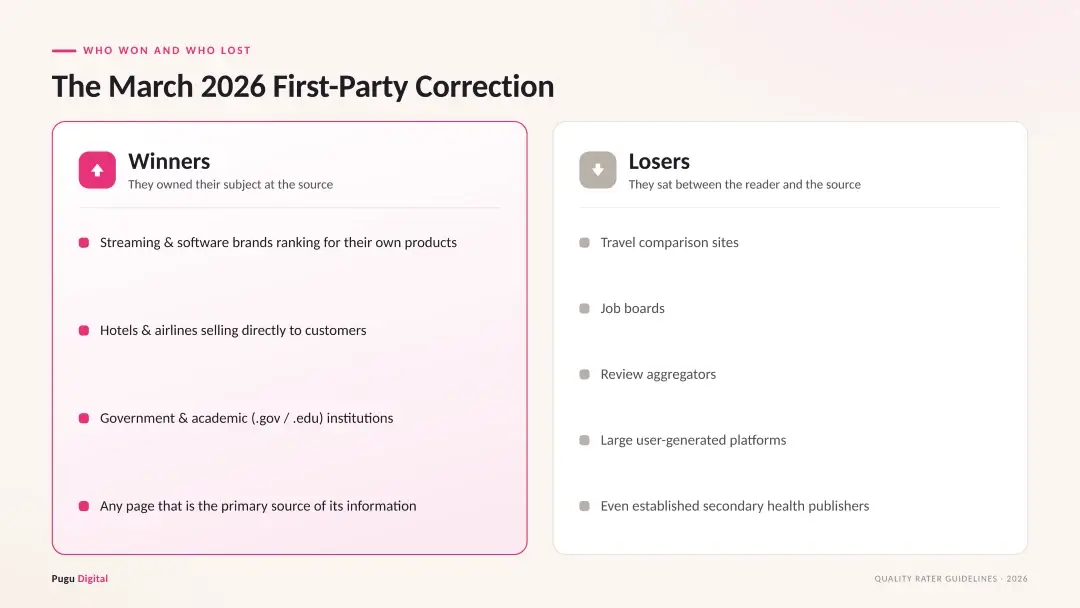
The losers shared the opposite trait: they sat between the reader and the source. Travel comparison sites, job boards, review aggregators and large user-generated platforms lost visibility. Even established secondary health publishers slipped, which rules out the easy explanation that Google was simply rewarding large brands. The update favored the original, authoritative source over any site that repackaged its information, regardless of that site’s SEO strategy, size or reputation.
For anyone running a content operation, the lesson is direct. If your page mainly summarizes what others have already published, you are now competing against those originals, and Google is increasingly favoring them.
What This Means for E-E-A-T in Practice
Pull the confirmed updates and the March core update together and a clear operating model emerges. None of it depends on an unconfirmed rulebook. It follows from what Google has actually said and done.
Trust Is Still the Foundation
Trust remains the most important part of E-E-A-T. A page can look expert and authoritative and still fail if a reader (or a rater) cannot trust who produced it or why. Everything below is really about making your trustworthiness legible, both to people and to the systems reading your pages.
Experience Has to Be Visible, Not Claimed
Experience is the pillar Google has pushed hardest since 2022. The practical test is whether your content shows evidence that the author actually did the thing they are writing about. For an agency, that means naming the client sector, the scope of the work, and the measurable result. “We help clients improve conversions” tells the reader nothing. “We rebuilt an iGaming operator’s onboarding flow and cut drop-off by 22%” shows firsthand work, even without naming the client.
First-Party Value Beats Repackaging
The March update made this concrete. If your competitive edge is speed of summarization, that advantage is now at risk. If your edge is original data, direct experience, a distinct point of view, or genuinely useful analysis a reader cannot get from the source material alone, you are aligned with where Google is heading.
AI Content Is Fine, Scaled Thin Content Is Not
Google’s position has been steady: it aims to reward high-quality content however it is produced. AI is a tool. The failure mode it penalizes is scaled content abuse, meaning high volumes of pages created primarily to rank rather than to help.
A useful working rule for AI-assisted drafts: a human should add something the model could not, whether that is judgment, a real example, a correction, or a point of view. If a page is just a competent summary under a generic byline, it is exactly the kind of content the March update pushed down.
A Practical Compliance Checklist
You do not need to react to rumors. You do need to make your experience and trust signals obvious. Here is a focused sequence you can run in a week.
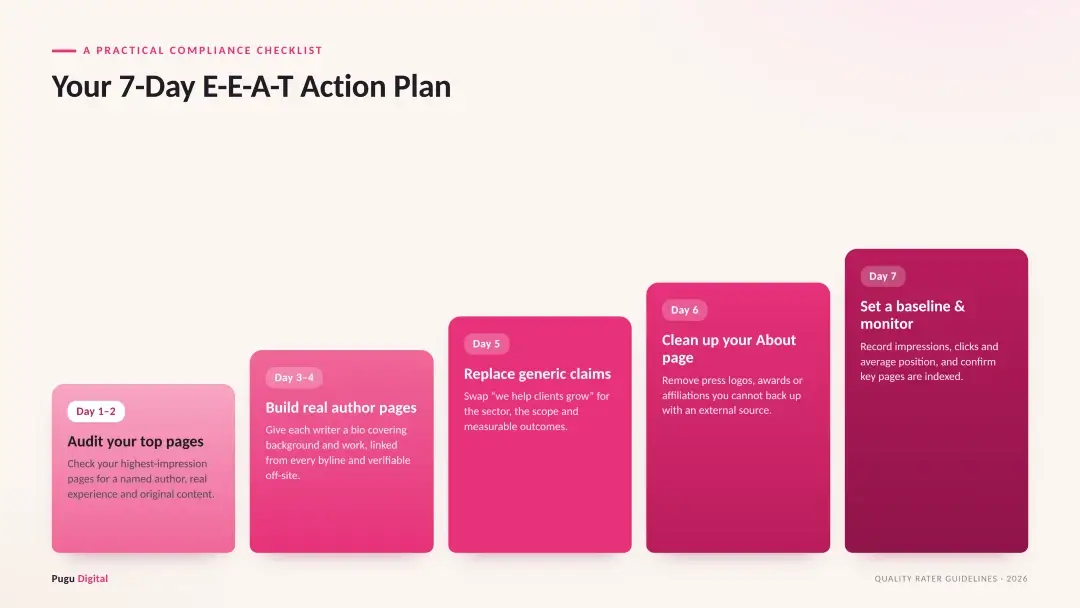
Day 1 to 2: Audit your highest-value pages. Pull your top pages by impressions in the Search Console for the last three months. For each, check three things: is there a named author, is there visible evidence of firsthand experience, and is the content original rather than a summary of other sources? Flag anything with an anonymous or “editorial team” byline that is pulling real traffic.
Day 3 to 4: Build real author pages. Give each author a dedicated bio page covering their background, expertise and relevant work, and link it from every byline. Add external verification where you can, for example a link to a real LinkedIn profile, so the credentials can be confirmed off your own domain. A claim a reader cannot verify anywhere but your site does little for trust.
Day 5: Replace generic claims with specific evidence. Swap “we help clients grow” for concrete detail: the sector, the scope, the outcome. Where you can share numbers, share them. Where you cannot name a client, describe the work precisely enough that the experience still reads as real.
Day 6: Clean up your About page. Remove press logos, awards or affiliations you cannot back up with an external source. An honest, modest About page beats an inflated one. Overstated credentials that do not appear anywhere off your site work against your trust signals, not for them.
Day 7: Set a baseline and monitor. Record current impressions, clicks and average position in Search Console, and confirm your key pages are indexed in their current form. This gives you something to measure against as the effects of the next core update roll out.
Conclusion: Google’s Quality Rater Guidelines
The honest version of the 2026 story is less dramatic than some headlines suggest, and more useful. Google did not quietly rewrite the rulebook in June. It refreshed the guidelines in September 2025, kept its rating philosophy intact, and then let a volatile March 2026 core update do the real reshaping. That update rewarded original, first-party, trustworthy sources and demoted the sites that mainly repackage them.
For content teams, the takeaway is practical. Put a real, credible person behind your work. Show the experience instead of claiming it. Publish things a reader cannot get from a summary. Do that, and you are aligned not with a rumor, but with the direction Google has actually been moving.
If you want a hand auditing your site against these standards, that is exactly the kind of work we do at Pugu Digital.
Google’s Quality Rater Guidelines FAQs
What are Google’s Quality Rater Guidelines and do they affect rankings?
They are the instructions Google gives human evaluators who rate sample search results. Those ratings do not change any individual page’s ranking. They train the quality systems that power both search results and AI answers, so they signal the standards Google is working toward.
Was there a June 2026 Quality Rater Guidelines update?
There is no confirmed Google guidelines release in June 2026. The most recent confirmed update was September 11, 2025, which Google called minor and said made no change to its rating guidance. Claims of a major June overhaul trace to individual commentary, not Google’s own documentation, so verify before relying on them.
What actually changed search results in 2026?
The March 2026 core update, announced March 27 and completed April 8. It was highly volatile (around 79.5% of top-three results moved) and favored first-party, official and authoritative sources over aggregators, user-generated platforms and pages built mainly for search traffic.
Does Google penalize AI-generated content?
Not on its own. Google aims to reward helpful, original content however it is produced. What it penalizes is scaled content abuse: high volumes of low-value pages made primarily to rank. AI-assisted content works when a human adds genuine value the model could not. For any assistance, our team stand ready to help.
What is the single most important thing to fix?
Make your experience and trust signals visible. Put named, verifiable authors behind your content, and show specific, firsthand evidence of the work rather than generic claims. That is what both the guidelines and the March 2026 update reward.