
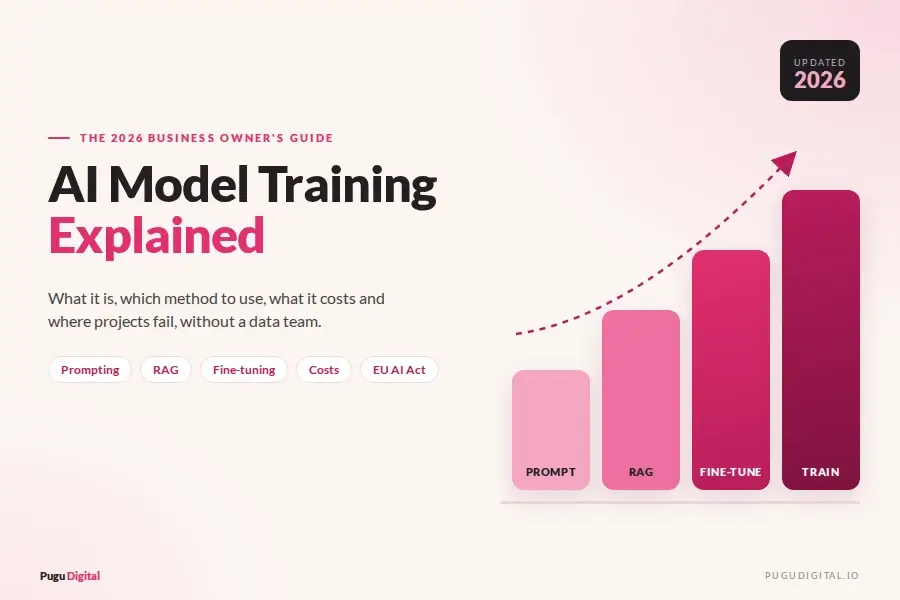
AI model training is the process of teaching a model to do a specific task by showing it examples, measuring its mistakes, and adjusting it until the results are reliable. In 2026, most businesses will never train a model from scratch. They start with a pre-trained model and pick the lightest option that works: better prompts, then retrieval over their own documents (RAG), then fine-tuning.
AI Model Training Key Takeaways
- Start with one measurable problem. “Route 60% of support tickets automatically while keeping satisfaction above 4.2” is a goal. “Use AI in customer service” is not.
- Try prompting and RAG before fine-tuning. If the model lacks facts about your business, RAG fixes it. If it lacks a skill, format or tone, fine-tuning fixes it.
- Data quality beats data volume. A few hundred clean, well-labelled examples often outperform thousands of messy ones.
- Build a test set before you build anything else. 50 to 200 real cases with the correct answers is how you prove the model works and catch vendor overpromises.
- Budget for data prep and hosting, not just training. The training run is usually the cheapest line item.
- Check the rules. EU transparency duties for AI apply from 2 August 2026, and high-risk obligations (hiring, credit, education) follow on 2 December 2027.
Most owners still assume training requires a data science team and a Silicon Valley budget. That stopped being true around 2023. In 2026, the gap between businesses that get value from AI and those that don’t is about execution, not access.
This guide covers what training actually means, which method to use, how the process runs, what it costs, and where projects fail.
What is AI Model Training?
AI model training means feeding a model examples, letting it predict, scoring each prediction against the right answer, and nudging its internal settings (called weights) to reduce the error. Repeat that millions of times and the model learns patterns it can apply to new cases.
Think of onboarding a new support hire. You don’t hand them a manual and walk away. You show them real tickets, let them draft replies, correct the bad ones, and repeat until they’re reliable. Training works the same way, except the “employee” handles thousands of cases an hour and never forgets a correction.
Where Your Business Data Fits in
Every email, order, support ticket, and inventory movement is potential training material. The model studies what happened in the past and uses those patterns to predict what happens next, or to automate repetitive work. The catch: raw business data is rarely training-ready. It usually needs cleaning, de-duplicating, and labelling first.
Where Training Pays Off Most in 2026
Training earns its keep on repetitive, high-volume decisions where you can check the answer:
- Classification: routing tickets, tagging documents, flagging fraud among thousands of legitimate transactions.
- Prediction: churn risk, demand forecasting, lead scoring.
- Consistent output: product descriptions in your brand voice, structured data extracted from invoices or emails.
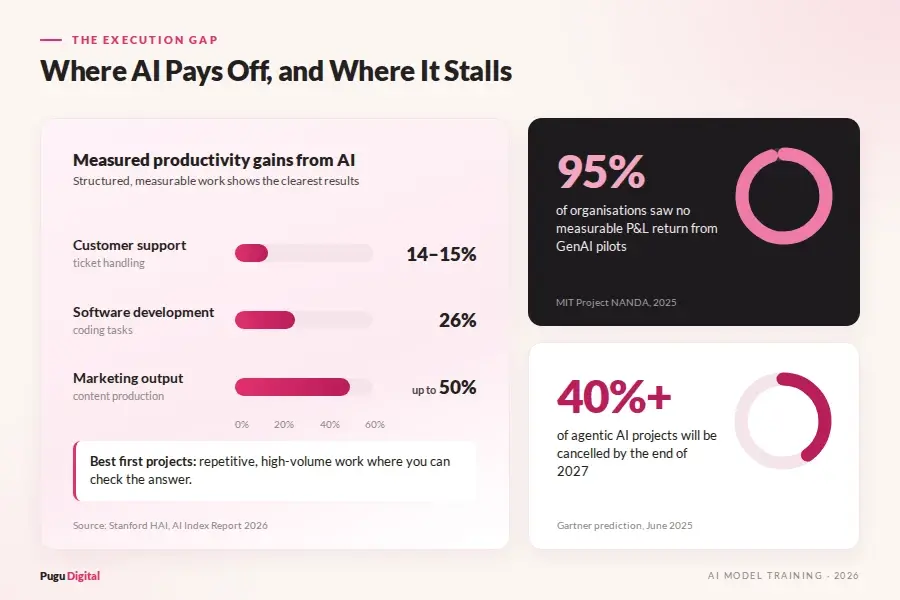
Stanford’s 2026 AI Index reports measured productivity gains of roughly 14 to 15% in customer support, 26% in software development, and up to 50% in marketing output. These are the areas where results are easiest to measure, which is exactly why they’re good first projects.
Training and AI Agents
In 2026, the conversation has shifted to agentic AI: systems that don’t just flag a problem but act on it, such as rerouting a ticket, adjusting a reorder, or approving a routine refund. An agent is only as reliable as the model and the tests behind it. Gartner predicts that over 40% of agentic AI projects will be cancelled by the end of 2027 because of rising costs, unclear value or weak risk controls. The fundamentals in this guide are what separate the projects that survive.
Your Role Versus Your Technical Partner’s
You don’t need to code. Your job is to define the problem, supply representative data, decide what “good” looks like, and sign off on the test results. Your technical partner picks the method, runs training, and handles deployment. When you review a proposal, ask three questions:
- What data do you need from us, and how clean must it be?
- How will you test the model, and can we see results on our own cases?
- What happens when the model meets a situation it wasn’t trained on?
Do You Actually Need to Train a Model? Prompting vs RAG vs Fine-Tuning
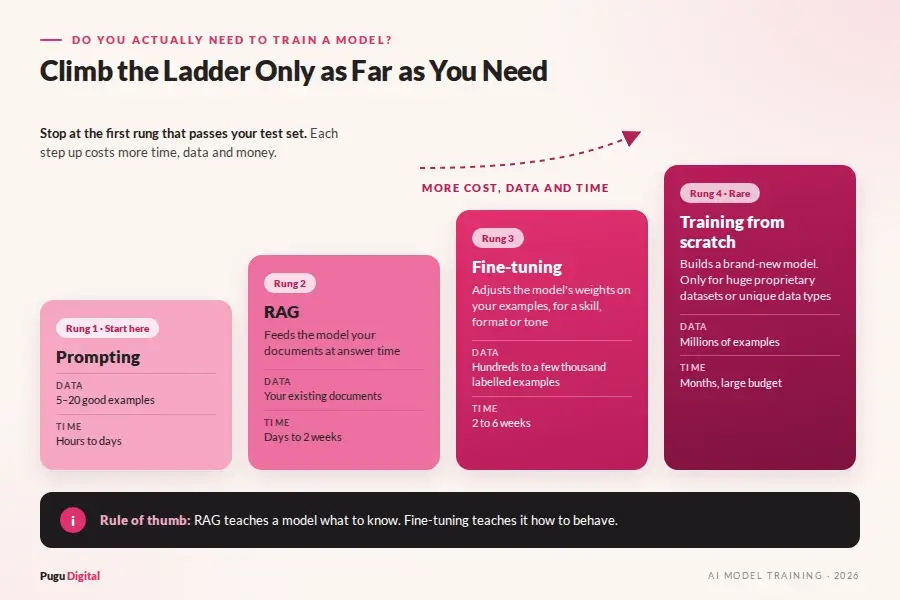
Most business problems in 2026 are solved without changing a model’s weights at all. Before paying for training, work down this ladder and stop at the first rung that meets your test set.
| Approach | What it changes | Best for | Typical data needed | Typical time to first result |
|---|---|---|---|---|
| Prompt engineering | Instructions and examples sent with each request | Tone, format, simple rules | 5 to 20 good examples | Hours to days |
| RAG (retrieval-augmented generation) | Gives the model your documents at answer time | Facts that change: prices, policies, product specs, help-centre content | Your existing documents, cleaned and chunked | Days to 2 weeks |
| Fine-tuning | Adjusts the model’s weights on your examples | A repeatable skill, strict output format, brand voice, cheaper and faster responses at scale | Hundreds to a few thousand labelled examples | 2 to 6 weeks |
| Training from scratch | Builds a new model | Rare: huge proprietary datasets or unique data types | Millions of examples | Months, large budget |
A simple rule from practice: RAG teaches a model what to know, fine-tuning teaches it how to behave. A support bot that quotes outdated prices needs RAG. A support bot that knows the prices but writes in the wrong tone or breaks your ticket format needs fine-tuning. Many production systems combine both.
One more reason to start with RAG: when your prices or policies change, you update a document instead of retraining a model.
The Main AI Training Methods, Explained for Business
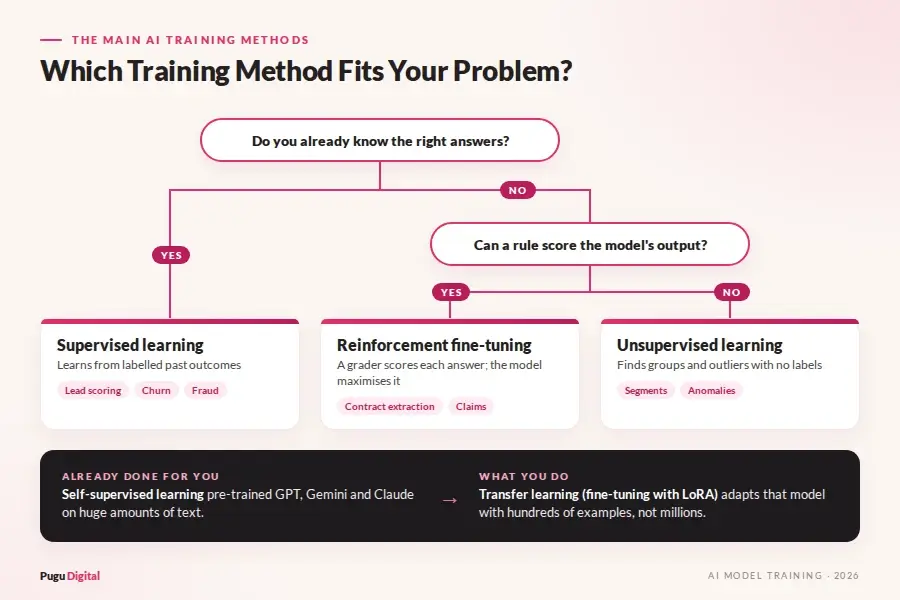
Five training methods cover almost every business use case: supervised, unsupervised, self-supervised, reinforcement learning, and transfer learning (fine-tuning). The right one depends on whether you know the correct answers in advance.
1. Supervised Learning: When You Know the Right Answer
You show the model thousands of examples where the outcome is already known: which leads converted, which customers churned, which transactions were fraud. The model learns to spot the same signals in new data.
Spam filters are the classic example. Providers trained them on millions of emails already marked spam or legitimate. Most business predictions fit here: lifetime value, demand, ticket priority. The cost is labelling. Someone with domain knowledge has to mark the right answers, and that takes longer than most owners expect.
2. Unsupervised Learning: Finding Patterns You Didn’t Know Existed
Here the model gets data with no answers attached and groups similar items or flags outliers on its own. Customer segmentation is the best-known use: the model clusters buyers by purchase history and behavior, often revealing segments that demographics miss.
Anomaly detection works the same way, learning what “normal” looks like and flagging anything that deviates, such as a fraud pattern nobody has seen before.
3. Self-Supervised Learning: How Today’s Large Models are Built
Large language models like GPT, Gemini, and Claude learn by predicting the next word across enormous amounts of text. The data labels itself, because the “answer” is simply the next word.
You will almost never run this stage yourself, but it explains why pre-trained models already understand language, and why you only need a small amount of your own data on top.
4. Reinforcement Learning: Learning from Feedback and Rewards
The model tries actions, receives a reward or penalty, and adjusts. Classic uses include dynamic pricing and inventory optimization, where the system tests ordering or pricing strategies and learns from the results.
In 2026, the bigger business story is reinforcement fine-tuning (RFT). Instead of labelling every answer, you write a scoring rule (a “grader”) that rates the model’s output, and the model is trained to maximize that score. OpenAI, Amazon Bedrock and Google’s Gemini Enterprise Agent Platform all now offer RFT as a managed service.
It suits tasks with a checkable answer, such as extracting the right fields from a contract or classifying claims correctly. A related technique, RLHF (reinforcement learning from human feedback), is how chat assistants learn to be helpful. Chatbots do not improve on their own in production: someone has to collect the feedback and run a new training round.
5. Transfer Learning and Fine-Tuning: The Default for Small Businesses
You take a model already trained on huge datasets and adapt it with your own examples. It’s like hiring an experienced professional and teaching them your procedures instead of training a graduate from zero.
Most fine-tuning in 2026 uses parameter-efficient methods such as LoRA (low-rank adaptation), which adjust a small add-on layer instead of the whole model. That cuts cost and hardware needs sharply and lets you keep several tuned versions of one base model. The same idea applies to images: a vision model that already recognizes shapes and objects can learn your product defects from a few hundred photos.
This is why fine-tuning is now the standard route for small businesses: hundreds of examples instead of millions.
How to Train an AI Model for Your Business: 6 Steps
The process has six steps: define the problem, build a test set, prepare the data, choose a platform and base model, train and validate, then test and monitor. Treat it like opening a new location: clear goals, proper preparation, and a way to measure success.
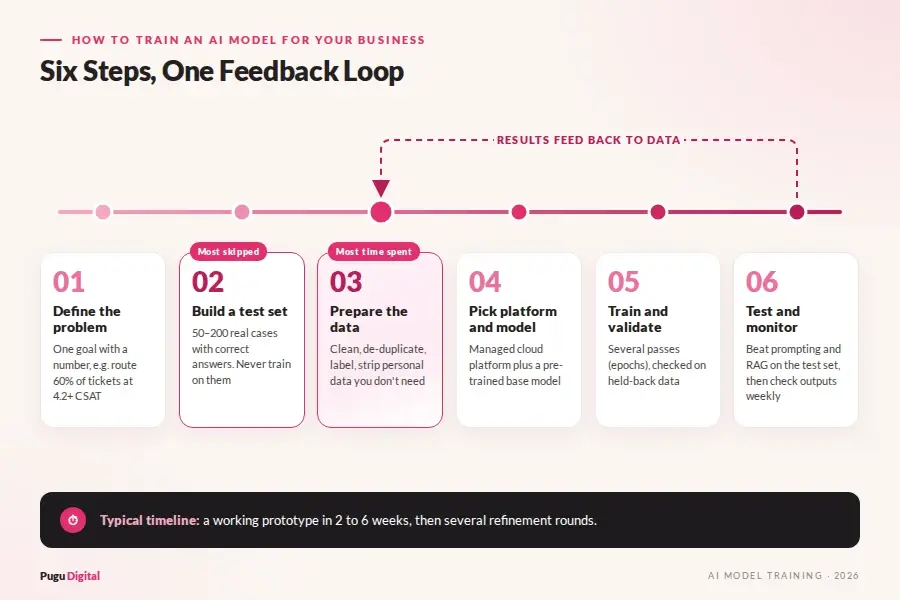
The dotted line matters: successful projects loop back to the data several times.
Step 1: Define Exactly What Problem You’re Solving
Most projects go wrong here by starting with the technology instead of the problem. “We want to improve customer service” is like saying you want to make more money: true, but useless. “Route 60% of support tickets automatically while keeping satisfaction scores above 4.2 stars” gives everyone a target and a finish line.
Step 2: Build Your Test Set First
Before any training, collect 50 to 200 real cases with the correct answers, set them aside, and never train on them. This “eval set” is how you compare vendors, check whether prompting or RAG is already good enough, and prove the final model works. In my experience, though, I normally don’t do this on my own, teams that skip this step are the ones that can’t explain six months later whether the project succeeded.
Step 3: Get Your Data House in Order
Data preparation usually takes the biggest share of project time, and few vendors mention it upfront. Customer names in different formats, dates split across systems, and tickets missing resolution codes all need fixing. Quality beats quantity: a thousand clean, well-labelled examples beat ten thousand messy ones. Strip out personal data you don’t need, and confirm you have the right to use the rest for training under GDPR or your local privacy law.
Step 4: Pick the Platform and Base Model
You don’t need to understand neural networks any more than you need to understand combustion engines to buy a delivery van. Managed platforms handle the architecture and let you fine-tune leading models through a web console or API. The main options in 2026:
| Platform | Company | Fine-tuning options (as of September 2026) |
|---|---|---|
| Gemini Enterprise Agent Platform (formerly Vertex AI, renamed April 2026) | Supervised fine-tuning of Gemini models; reinforcement fine-tuning in preview | |
| Amazon Bedrock and Amazon SageMaker AI | Amazon | Supervised and reinforcement fine-tuning of Nova and open models such as Llama and Qwen |
| Microsoft Foundry (formerly Azure AI Foundry, renamed January 2026) | Microsoft | SFT, DPO and RFT on OpenAI models plus open models like Llama and gpt-oss |
| OpenAI API | OpenAI | Supervised fine-tuning (GPT-4.1 family) and reinforcement fine-tuning |
| Together AI, Fireworks, Hugging Face | Independent | Low-cost LoRA fine-tuning of open-weight models |
Product names and supported models change often, so check each provider’s current documentation before you commit. Your choice still affects performance, cost, and where your data is stored.
Step 5: Train and Validate
Training runs in the background while your team works. The system passes over your data several times (each pass is an “epoch”) and adjusts its weights until predictions improve. Validation runs alongside, using held-back data the model hasn’t seen, to check it’s learning general patterns rather than memorizing examples.
Step 6: Test Before Go-Live, Then Keep Monitoring
Run the finished model on your eval set from step 2 and compare it with the base model and with a plain prompting or RAG setup. If fine-tuning doesn’t clearly beat the simpler options, don’t ship it. After launch, sample real outputs every week. Customer questions, products, and prices drift, and a model that scored 92% in March can quietly slip by summer.
A focused project with clean data typically reaches a working prototype in two to six weeks. Expect several rounds of refinement before it’s production-ready.
How Much Does AI Model Training Cost in 2026?
The AI model training run itself is often cheap, from a few dollars to a few hundred for a small fine-tune. The real costs are data preparation, testing, hosting, and staff time.
A worked example: 1,000 training examples of about 1,000 tokens each (roughly 750 words), trained for 3 epochs, is 3 million training tokens. At published 2026 rates that is:
| Model | Approx. training price per 1M tokens | Cost of the example run |
|---|---|---|
| Open-weight 7B model on Together AI | $0.48 | About $1.50 |
| OpenAI GPT-4.1 mini | $5 | About $15 |
| OpenAI GPT-4.1 | $25 | About $75 |
Prices from AICostCheck’s 2026 comparison; reinforcement fine-tuning on OpenAI is billed by training time instead (listed at around $100 per hour). Always confirm on the provider’s own pricing page.
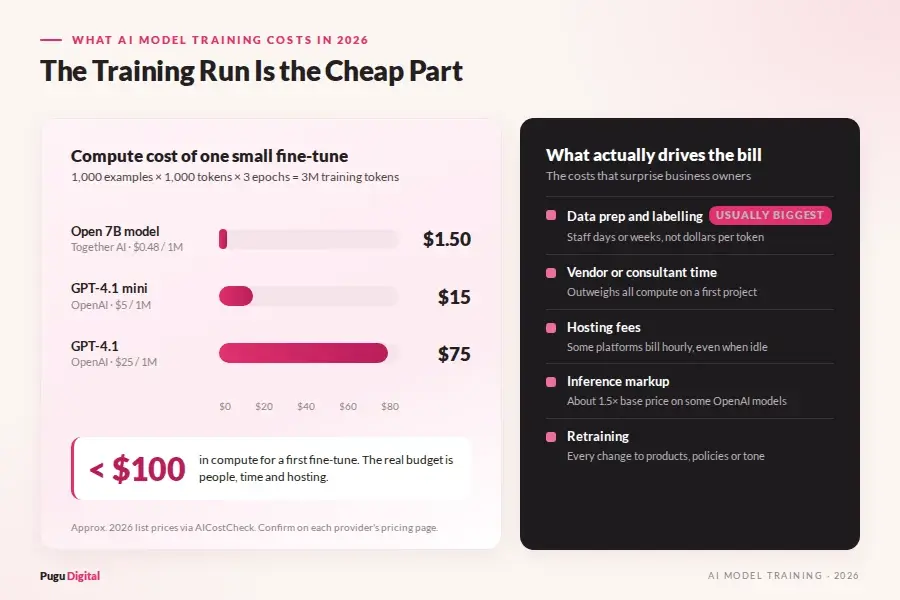
The costs that surprise owners:
- Data preparation and labelling: usually the largest cost, measured in staff days or weeks rather than dollars per token.
- Inference markup: some providers charge more to run a fine-tuned model than the base model (OpenAI lists roughly 1.5x for GPT-4.1 and GPT-4o), while Google and most open-model hosts charge the base rate.
- Hosting fees: on Microsoft Foundry, a deployed fine-tuned model incurs an hourly hosting charge whether or not anyone uses it. Delete test deployments you no longer need.
- Retraining: every time your products, policies or tone change, you may need a new training round. RAG avoids much of this.
- Vendor or consultant time: for a first project, this typically outweighs every compute cost combined.
Measuring ROI is easier if you tie the project to a number you already track. That can be handling time per ticket, hours spent on manual data entry, stock-outs per month. Measure it before launch so you have a baseline.
Get a Clear Price Before You Commit
Every AI project is different, and generic price tables only take you so far. The training run might cost $15, but data preparation, testing, and hosting are what shape your real budget. Those costs depend on your data, your goals, and the tools you already use.
That’s where Pugu Digital comes in. We’ve worked in digital marketing since 2013 and now help businesses bring AI into their daily work, from choosing the right approach to getting a model live and measured.
When you reach out, we’ll:
- Review your use case and tell you honestly whether you need prompting, RAG or fine-tuning, or no AI at all.
- Check your data so you know what’s usable today and what needs cleaning first.
- Give you a fixed, itemized quote covering data prep, setup, testing and running costs, with no surprise line items later.
- Map out a realistic timeline with clear milestones and a baseline to measure results against.
You’ll get straight answers in plain language, not jargon or oversized proposals.
Book a consultation with Pugu Digital → Contact us
Why AI Projects Fail: the 5 Most Common Roadblocks
Most failed AI projects fail on data, workflow fit, and governance, not on the model. RAND’s analysis of failed projects and MIT’s 2025 GenAI Divide report point to the same causes: vague requirements, poor data, and tools that never fit into daily work.
1. Data Problems
A model is only as good as its data. Missing records, inconsistent product codes, and outdated prices compound during training. Labelling is the bigger hurdle: fraud detection needs analysts to classify transactions, and support automation needs staff to tag tickets by type and urgency. Owners often say “we have plenty of data” and then find most of it needs cleaning first.
2. Overfitting and Underfitting
Overfitting means the model memorized the training examples instead of learning the pattern. It scores brilliantly in training and stumbles when a customer phrases the same question differently. Underfitting is the opposite: the model is too simple, for example, predicting churn from order value alone while ignoring seasonality and buying history. A proper held-out test set (step 2 above) is how you catch both.
3. Hallucinations and Drift
Generative models can state wrong facts with total confidence. Fine-tuning doesn’t cure this, and can make it worse if the training data contains facts that later change. Ground factual answers in your documents with RAG, and keep monitoring after launch.
4. Bias and the New AI Rules
Models absorb the biases in historical data. A hiring model can favor certain groups if past decisions did, and a credit model can repeat old lending disparities. Anti-discrimination, fair lending, and employment laws apply to AI decisions just as they do to human ones, and dedicated AI rules are now arriving:
| Rule | What applies | When |
|---|---|---|
| EU AI Act, Article 50 | Tell users when they’re interacting with AI; label AI-generated content | From 2 August 2026 (machine-readable marking for systems already on the market from 2 December 2026) |
| EU AI Act, high-risk systems (Annex III: hiring, credit scoring, education, critical infrastructure) | Risk management, documentation, human oversight, bias testing | Delayed by the Digital Omnibus to 2 December 2027 |
| Colorado ADMT law (SB 26-189) | Replaces the 2024 Colorado AI Act with narrower disclosure duties and a right to human review of adverse automated decisions | From 1 January 2027 |
If your model touches hiring, lending, housing, insurance or education, test its outputs across customer groups and document the results now. It’s cheaper than retrofitting later. This is general information, not legal advice; check with a lawyer for your markets.
5. Cloud or Local?
Cloud platforms handle the complexity but mean ongoing fees and sending data to an external provider, which some regulated industries restrict. Running open-weight models on your own hardware gives full data control and no per-token fees, but you pay upfront for GPUs and handle maintenance. For most small businesses, a managed cloud platform with an EU or local data region is the practical choice. Revisit it if volumes grow or data rules tighten.
Getting AI training Right: a 90-day Starter Plan
The businesses getting value from AI in 2026 start small, measure everything, and treat AI as an ongoing capability, not a one-off project.
- Weeks 1 to 2: pick one problem with a number attached (response time, forecast error, hours of manual entry). Record today’s baseline.
- Weeks 2 to 3: build the eval set of 50 to 200 real cases with correct answers.
- Weeks 3 to 5: test prompting and RAG on a managed platform. Stop here if they hit the target.
- Weeks 5 to 10: if not, clean and label training data and run a fine-tune. Compare against the eval set.
- Weeks 10 to 12: pilot with real users, keep a human reviewing outputs, and set up weekly monitoring.
Pick partners who explain decisions in business terms and show results on your data, not demo data. Appoint an internal AI champion: someone who understands your data well enough to ask hard questions when a vendor promises magic.
AI Model Training Conclusion
You don’t need to become a technical expert to train AI for your business. You need a clearly defined problem, clean data, a test set, and a partner who can prove results. Start with the lightest option that works (prompting, then RAG, then fine-tuning), measure against a baseline, and plan for several rounds of improvement. Most importantly, start organizing your data now.
Clean, structured information is the foundation for every AI project, whether you train your first model this year or next. If you like this guide, give us a comment and share the article amongst your colleagues and friends.
AI Model Training Frequently Asked Questions
What is AI model training in simple terms?
AI model training is teaching a computer model to do a task by showing it many examples, checking its answers, and adjusting it until it gets them right consistently. For most businesses in 2026, it means fine-tuning an existing model on their own data rather than building one from scratch.
What’s the first step in training an AI model for my business?
Define one measurable problem, such as “route 60% of support tickets automatically while keeping satisfaction above 4.2 stars”. Then collect 50 to 200 real examples with correct answers to use as a test set. Most first projects fail because the goal was too vague to measure.
What is the difference between fine-tuning and RAG?
RAG (retrieval-augmented generation) gives a model access to your documents at the moment it answers, so it can use current facts like prices and policies. Fine-tuning changes the model itself so it learns a skill, format or tone. Use RAG for knowledge that changes and fine-tuning for behavior that must be consistent.
How is training a model different from just using ChatGPT or Gemini?
Off-the-shelf tools like ChatGPT, Gemini or Claude handle general tasks well but don’t know your business. Fine-tuning or RAG teaches them your catalogue, support history or terminology, so they perform your specific tasks more accurately and consistently.
Do I need an in-house data scientist?
No. Managed platforms from Google, Amazon, Microsoft, and OpenAI handle the technical mechanics. You need someone internally who understands your data and can define success clearly. Call them your AI champion.
How much data do I need to fine-tune a model?
Some providers accept as few as 10 examples, but useful results usually need a few hundred to a few thousand high-quality examples. Quality matters far more than volume.
How much does it cost to train an AI model?
A small fine-tune of 1,000 examples can cost under $100 in compute at 2026 prices. Data preparation, testing, hosting, and vendor time usually cost far more than the training run itself.
How long does it take to implement an AI system for a small business?
A focused project on a pre-trained model can reach a working prototype in two to six weeks. Custom or multi-system projects take several months. Data quality and how clearly you define the problem are the biggest factors.
Is my business affected by the EU AI Act?
If you serve EU customers with an AI system, transparency duties such as telling users they’re talking to AI apply from 2 August 2026. Stricter obligations for high-risk uses like hiring and credit scoring apply from 2 December 2027. Check with a legal adviser for your specific case.