
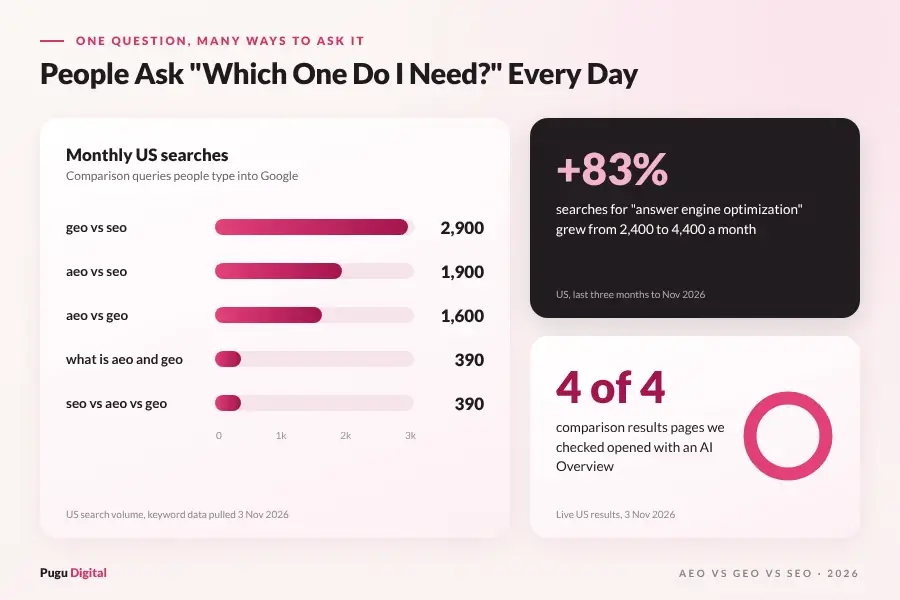
AEO vs GEO vs SEO is the question we hear most from clients right now. Do we need AEO? Should we be doing GEO? Is SEO still worth paying for? The acronyms keep multiplying, and so do the agencies selling each one as its own service.
Here’s what we know for certain. In May 2026, Google published its own guide to optimizing for AI search, and it takes a clear position: from Google Search’s point of view, AEO and GEO are still SEO. That settles it for AI Overviews and AI Mode. It doesn’t settle it for ChatGPT, Perplexity or the Gemini app, which choose their sources in their own ways.
Whichever order you put the letters in (AEO vs GEO, GEO vs AEO, SEO vs AEO vs GEO), the question underneath is the same. This post covers both halves of it: what Google says, and what changes once you leave Google.
Key Takeaways:
- For Google Search, AEO and GEO are still SEO. Google says so in its own AI search guide, published in May 2026.
- AI Overviews and AI Mode pull their sources from Google’s normal index and rankings, so a page that doesn’t rank rarely gets cited.
- You can skip llms.txt, content chunking and special AI schema for Google. Indexing, snippet eligibility and genuinely useful content are what count.
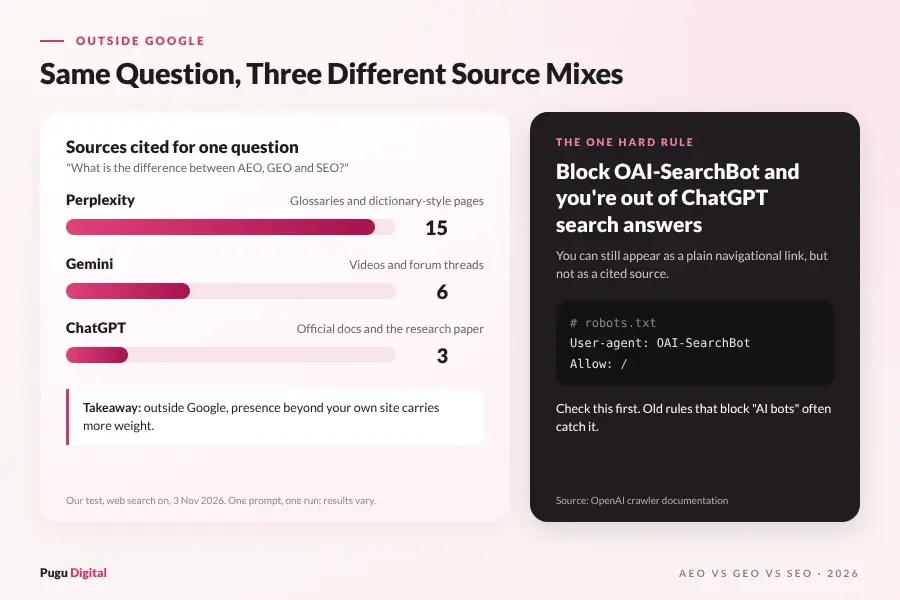
- Outside Google, a few things change. Blocking OAI-SearchBot keeps you out of ChatGPT search answers, and each AI engine leans on different kinds of sources.
- Search Console’s Generative AI report shows how often your pages appear in AI answers, but it reports impressions only, not clicks.
- In YMYL niches like iGaming, accuracy and real authorship now carry more weight than ever.
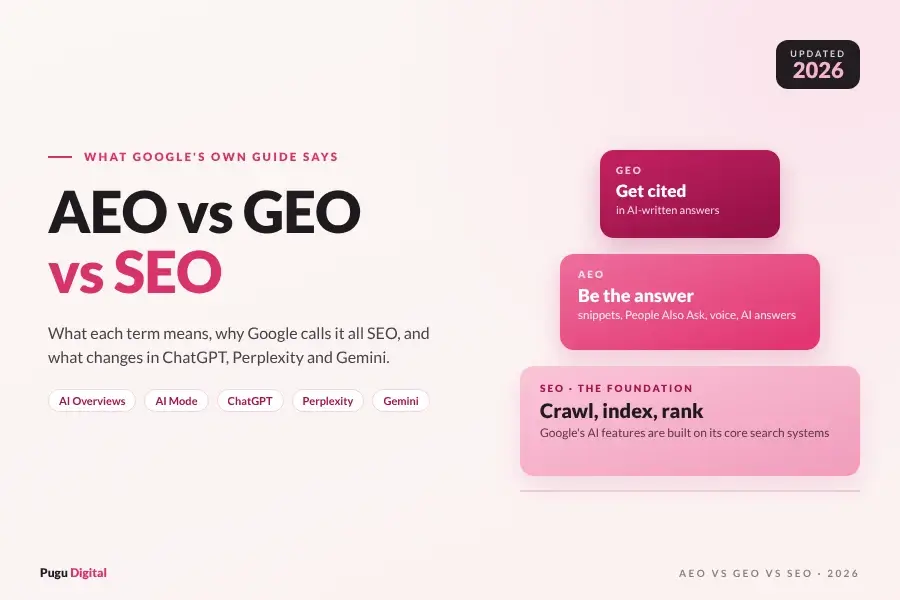
AEO (answer engine optimization) aims to make your content the direct answer in featured snippets, voice results and AI answers. GEO (generative engine optimization) aims to get your brand cited inside AI-generated responses. SEO is the foundation both rely on. For Google Search, Google itself classes AEO and GEO as SEO.
AEO vs GEO vs SEO at a glance
| SEO | AEO | GEO | |
|---|---|---|---|
| Where it shows up | Organic results (the blue links) | Featured snippets, People Also Ask, voice answers, AI answers | AI-generated answers in AI Overviews, AI Mode, ChatGPT, Perplexity, Gemini |
| The goal | Rank the page | Be the answer | Be cited in the answer |
| What you get | Clicks to your site | Visibility, often without a click | Brand mentions and source links |
| How you measure it | Rankings, impressions, clicks | Snippet and answer visibility | Citations and mentions across AI engines |
| What Google says | The foundation | Still SEO on Google | Still SEO on Google |
An easy way to keep them apart: SEO ranks the page. AEO makes it the answer. GEO gets it cited.
The bottom row is the part most comparisons leave out. The first four rows describe real differences in where you show up and what you count. The last one tells you how much of the actual work is shared, at least on Google.
What is AEO?
In search marketing, AEO stands for answer engine optimization. (The same three letters mean a customs status in international trade, which explains some odd search results.) It’s the work of shaping a page so a search engine can lift a clean answer straight out of it.
The idea is older than AI search. It grew out of featured snippets, People Also Ask boxes and voice assistants reading out a single answer to a spoken question. If your page held that box, you were the answer, whether anyone clicked or not.
When AI answers arrived, the label stretched to cover them as well. Same goal, bigger surface.
In practice, AEO looks pretty plain. A heading phrased the way people actually ask. The answer in the first sentence under it. Then the detail, the caveats and the examples. When we restructure a client page, this is usually one of the first changes we make, because it costs almost nothing and helps both normal rankings and AI answers.
So when someone asks what AEO and GEO are together, the honest answer is two names for overlapping work, coined at different times for different surfaces.
GEO vs SEO: where they actually differ
GEO, short for generative engine optimization, is about getting your brand cited inside answers an AI writes on the spot. The term came out of a 2023 research paper on how generative engines choose their sources, which is why it sounds more academic than AEO.
Three things genuinely differ.
- The output. SEO earns a place in a ranked list. GEO earns a place inside a written answer, next to two or three other sources at most.
- The metric. SEO counts rankings and clicks. GEO counts citations and mentions, and plenty of those never produce a click.
- The scope. SEO usually means Google (and Bing). GEO covers any engine that writes answers, including ones that don’t run on Google’s index.
What doesn’t differ is the base. The AI still needs to find your page, trust it and understand it. That means crawlable pages, clear facts, real authority and content worth quoting.
So is SEO vs GEO a real choice? Not really. GEO without SEO has nothing to stand on, because an AI can’t cite a page it never retrieved. SEO without any thought for GEO works fine on Google (more on that below) but can leave gaps in the other assistants.
AEO vs SEO: a new name for answer optimization?
Honestly, most of what gets sold as AEO is good on-page SEO with a new label. Answer-first structure, clear headings, short paragraphs that make sense on their own. That isn’t a knock on it. It works. But it works because it’s SEO, not because there’s a hidden answer engine algorithm to crack.
The real trade-off in SEO vs AEO is the click. When your answer shows up in a snippet or an AI response, the searcher may get what they need and leave. For a simple definition, that’s traffic you won’t see. For a brand, it’s still your name in front of someone at the exact moment they asked the question. Given the choice, we’d rather be the answer and lose some clicks than lose both the click and the mention to a competitor.
What changes day to day is small. You write for the question, not for an exact keyword string. You answer it early, then back it up. And you stop padding intros to hit a word count, because a padded intro is exactly what pushes the answer down where nothing can find it.
Pages built this way tend to hold up in normal rankings too. That alone says a lot about how separate the two really are.
What Google says: AEO and GEO are still SEO
In May 2026, Google published Optimizing your website for generative AI features on Google Search, last updated in July 2026. It’s the first time Google has put its position on AI search optimization in writing, and it’s blunter than a lot of people expected.
The guide asks whether SEO still matters for generative AI search and answers with a plain yes. The reason it gives is structural. AI Overviews and AI Mode are rooted in Google’s core ranking and quality systems. They don’t run on a separate index or a separate rulebook.
Then it names AEO and GEO directly. From Google Search’s point of view, optimizing for generative AI search is optimizing for the search experience, which makes it SEO. The guide also suggests checking any third-party AEO or GEO advice against Google’s own guidance on hiring SEO help, which is about as pointed as Google gets.
That doesn’t mean nothing has changed. Answers now show up in new places, and a good result looks different from a ranked link. But the system that picks the pages is the same one.
It lines up with how we’ve approached client work all along, and it’s why we don’t sell AEO as a separate product for Google. There’s nothing separate to sell.
How AI Overviews pick their sources
Two parts of the guide explain why the “still SEO” line holds.
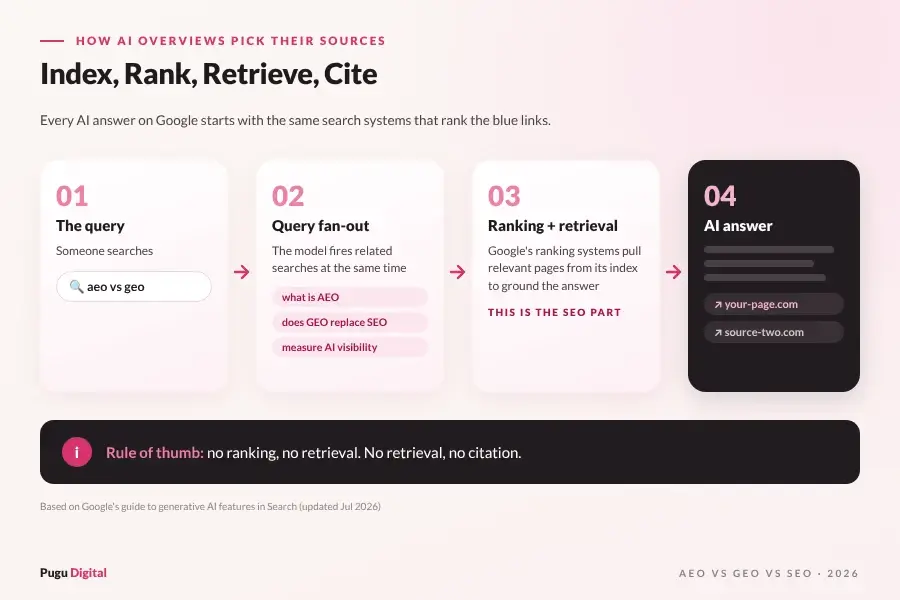
The first is retrieval. Before an AI Overview is written, Google’s ranking systems pull relevant, current pages from its index, and the answer is grounded in what those pages say. Google calls this retrieval-augmented generation, or grounding. No ranking, no retrieval. No retrieval, no citation.
The second is query fan-out. The model fires off several related searches at once to cover a question from different angles. Someone typing “aeo vs geo” might set off searches about what AEO means, whether GEO replaces SEO and how to measure AI visibility. Each of those has its own results, and each is another chance for your page to be pulled in.
What you can ignore (and what you can’t)
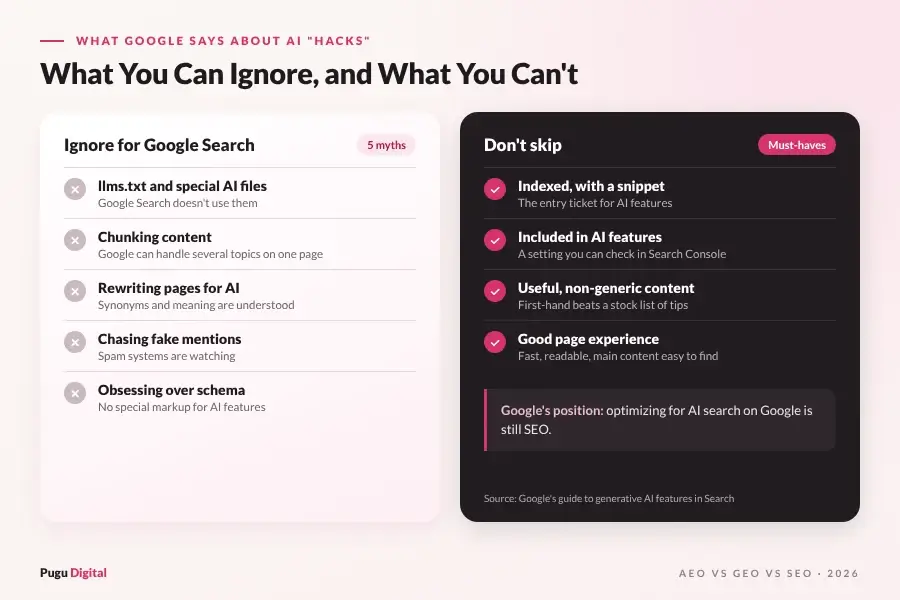
Google’s guide includes a short list of popular “AI hacks” you don’t need for Google Search. Paraphrased:
- llms.txt and other special AI files. Google Search doesn’t use them. Creating one won’t hurt, it just won’t help on Google. We looked at this in detail in our post on llms.txt.
- Chunking content into tiny pieces. Google’s systems can handle several topics on one page and surface the right part.
- Rewriting pages in a special style for AI. The systems understand synonyms and meaning, so you don’t need every long-tail variation.
- Chasing inauthentic mentions. Planting your brand name in forums and blogs isn’t as useful as it sounds, and spam systems are watching.
- Obsessing over structured data. There’s no special schema for AI features. It still earns rich results, so keep it, just don’t expect it to move AI visibility.
And the things you can’t skip:
- The page has to be indexed and eligible to appear with a snippet. That’s the entry ticket.
- Your site has to be included in Google’s generative AI features, a setting you can check in Search Console.
- The content has to be useful and not generic. Google’s own example contrasts a stock list of tips with a first-hand account of a real decision.
- Page experience still counts. Fast, readable, main content easy to find.
Is SEO dead? Not on Google, but outside Google a few things change
No. The question comes back every time Google changes something, and this time there’s an unusually official answer. Google’s guide says SEO still applies, because its AI features sit on top of its search systems.
AI Overviews now appear on a large share of searches, and AI Mode keeps expanding. Both depend on pages that are crawlable, indexed and ranking well. If anything, the bar went up. An AI answer shows far fewer sources than a page of ten blue links, so being merely relevant isn’t enough anymore.
The catch is scope. Google’s guide speaks for Google Search. It says nothing about how ChatGPT, Perplexity or the Gemini app pick their sources, and those engines don’t all behave the same way.
ChatGPT, Perplexity and Gemini
The one hard rule we know of comes from OpenAI. Its crawler documentation says that if a site opts out of OAI-SearchBot, it won’t be shown in ChatGPT search answers, though it can still appear as a plain navigational link. So check your robots.txt. A rule added a while back to block “AI bots” might be blocking the one you actually want.
Beyond that, the engines lean on different kinds of sources. When we put the same question about AEO, GEO and SEO to all three in November 2026, ChatGPT relied on official documentation and the original research paper. Perplexity went for glossary and dictionary-style pages. Gemini pulled from videos and forum threads.
The foundations stay the same. But outside Google, showing up beyond your own site (clear definitions, a video, real discussion in communities) carries more weight.
Where E-E-A-T and YMYL fit in
In October 2026, Google updated its page on creating helpful, reliable, people-first content, and two changes matter here.
First, raters now judge the main content of a page on four things: effort, originality, talent or skill, and accuracy. Effort is the interesting one. Text produced at scale with AI and no real human oversight counts as little or no effort, and crediting other sources doesn’t make up for having nothing original to add.
Second, for YMYL topics (anything that can affect someone’s money, health or safety), content has to be highly accurate and in line with expert consensus. Google also now calls fake author profiles, AI-generated headshots and made-up credentials what they are: deception, and a sign of a low-quality page.
If you’ve read Google’s quality rater guidelines, none of this is new in spirit. It’s just written down more plainly now.
Here’s what that looks like in our iGaming SEO work. On a Danish casino affiliate site we work on, we never copy age limits or licence details from comparison tables or other affiliates. We check each operator’s own site, because some Danish operators set a higher minimum age than the legal 18. One wrong number on a YMYL page is enough to undo the trust the rest of the page builds.
Building one AEO strategy instead of three
If the work overlaps this much, treating AEO vs GEO vs SEO as three separate programs makes little sense. This is the order we’d tackle it in.
- SEO comes first. Fix crawling, indexing and snippet eligibility before anything else.
- Structure key pages answer-first. The question as a heading, the answer right under it.
- Add what only you know. First-hand experience, real examples, your own process.
- Make authorship obvious. A real person, with real credentials, on the page.
- Show up beyond your own site, wherever that happens genuinely.
- Measure it.
Measure it where Google actually reports it. Search Console’s Generative AI report, under Performance, shows how often your pages appear in AI Overviews and AI Mode. Say a page gets 300 impressions there over three months but sits on page three in normal results. That’s 300 times Google’s AI used your page as a source while almost nobody saw the blue link. It’s impressions only, no clicks, so read it next to your regular performance data. The pages that show up in AI answers but barely rank are usually your quickest wins, because Google already trusts them as a source.
AEO vs GEO vs SEO FAQs
What is the difference between AEO and GEO?
AEO is about being the direct answer; GEO is about being cited inside an AI-written answer. On Google, both rest on the same SEO foundations.
Is AEO part of GEO?
They overlap so much that many people use the terms interchangeably. AEO is older and also covers non-AI surfaces like featured snippets and voice results.
What is SEO for AI called?
You’ll see AEO, GEO, LLMO and AI search optimization. Google’s own name for it is simply SEO.
Will AI replace SEO?
No. Google’s AI features retrieve pages from its search index, so they depend on the same work.
How is GEO different from SEO?
The output and the metric change, citations instead of rankings and clicks. The groundwork (crawlable, trustworthy, useful pages) stays the same.
Do you need separate AEO and GEO services?
For Google, no. Outside Google, a few extra tasks matter, such as crawler access and presence beyond your own site, but they belong in one plan, not three invoices.
Where to go from here
We help brands in regulated niches get found in normal search, AI Overviews and AI assistants without splitting the budget three ways. If that’s where you’re stuck, take a look at our GEO service.
How we researched this: Google’s AI optimization guide and helpful content page were read on 3 November 2026. Keyword and search results data came from our own SEO tooling (US and UK). The same AEO/GEO/SEO question was put to ChatGPT, Perplexity and Gemini on 3 November 2026.
About the author: Fredrik Oxhamre founded Pugu Digital in 2013. He has spent 10+ years in SEO, close to a decade in iGaming SEO, and the last two years on GEO and AI search visibility for regulated brands. He works in English, Swedish, and Danish. LinkedIn